“Breathing In, I Calm My Body”: a Gāthā by Thich Nhat Hanh
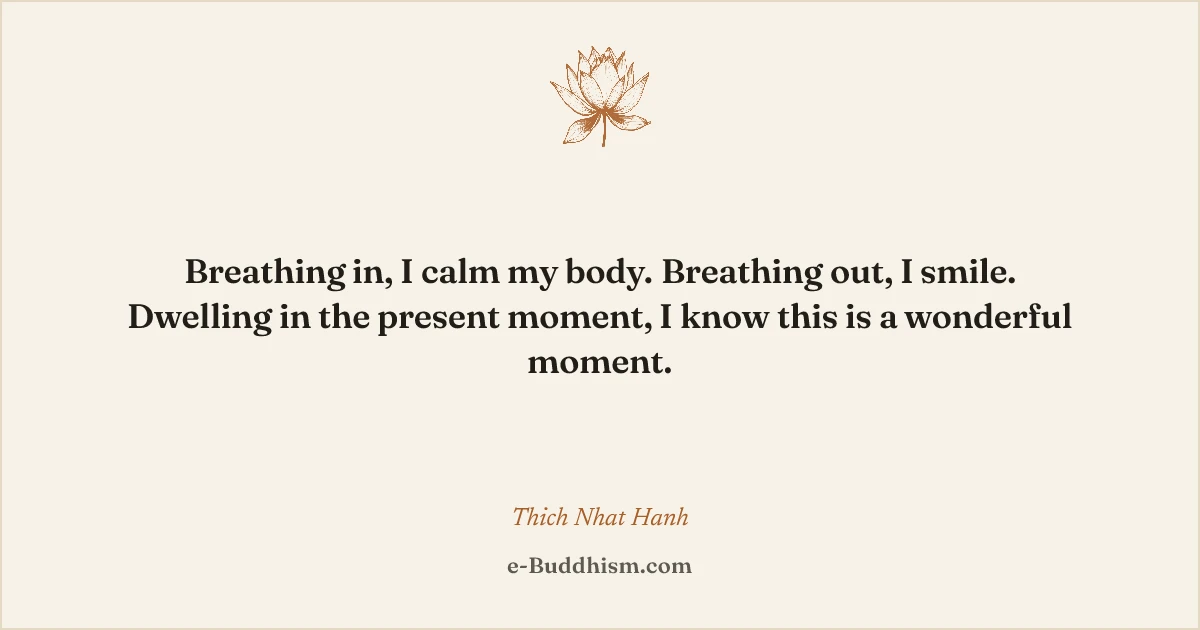
Some of the most useful Buddhist “quotes” are not statements at all but little verses you breathe with. This one, from the Zen master Thich Nhat Hanh, is perhaps the most loved: four short lines that calm the body, soften the face, and return you to the present. Here is the full gāthā, how to use it, and where it comes from.
Breathing in, I calm my body.
Breathing out, I smile.
Dwelling in the present moment,
I know this is a wonderful moment.
— Thich Nhat Hanh, Peace Is Every Step (1991)
What it means
A gāthā is a short verse meant to be recited silently while doing an ordinary thing, so that the activity becomes a doorway to awareness. This one is paced to the breath: the first line on an in-breath, the second on an out-breath, the third and fourth on the next pair. The words are not a thought to ponder but a handrail for the wandering mind to hold while you simply breathe.
Each line does a small, real thing. Calm my body — the breath naturally settles the nervous system. I smile — the faint half-smile Thich Nhat Hanh so often recommended, which gently changes the whole tone of the mind. Dwelling in the present moment — attention let down out of the imagined future and back into the one place life actually happens. This is a wonderful moment — not a forced positivity, but a noticing of the ordinary aliveness already here when we stop overlooking it.
Thich Nhat Hanh added that, once the verse is familiar, you can let it shrink to just its key words on each breath: “Calming, Smiling, Present moment, Wonderful moment.”
Where it comes from
The gāthā is from Peace Is Every Step: The Path of Mindfulness in Everyday Life (Bantam, 1991), in the section called “Present Moment, Wonderful Moment.” It is genuinely Thich Nhat Hanh’s, and we cite it as his words. (It is often shared truncated to two lines, or with “body and mind” — the book’s wording is the four lines above, calming “my body.”)
How to practise it
Try it now, for three breaths. Read the first line as you breathe in; the second as you breathe out; the third and fourth on the next two breaths. That is the whole practice — and it scales: the same verse can steady you in a waiting room, before a hard conversation, or in the middle of a sleepless night. For the tradition behind it, see mindfulness and the Buddha’s own mindfulness of breathing.
Browse more sourced lines in our Buddhist quotes collection.
Frequently asked questions
What is the full Thich Nhat Hanh breathing gāthā?
It has four lines: 'Breathing in, I calm my body. / Breathing out, I smile. / Dwelling in the present moment, / I know this is a wonderful moment.' Thich Nhat Hanh suggested it can be shortened, as you settle, to just the key words: 'Calming, Smiling, Present moment, Wonderful moment.'
How do you use it?
Recite the first line silently on an in-breath and the second on an out-breath, then the third and fourth on the next in- and out-breaths. The words give the wandering mind something gentle to hold while you simply breathe — calming the body, softening the face into a slight smile, and returning attention to the only moment there is.
What is a gāthā?
A gāthā is a short verse used in Buddhist practice to bring awareness to an ordinary activity — breathing, walking, eating, even washing the dishes. Thich Nhat Hanh made the gāthā famous in the West as a simple way to weave mindfulness through daily life. The words are his; the practice of mindful breathing is the Buddha's.
Sources
- Thich Nhat Hanh, Peace Is Every Step: The Path of Mindfulness in Everyday Life (Bantam, 1991), 'Present Moment, Wonderful Moment.'