“My Religion Is Kindness” — the Dalai Lama
It is perhaps the Dalai Lama’s most quoted sentence, and its appeal is its plainness: strip religion down to what matters most, he says, and you are left with kindness. No temple is needed for it, no complicated philosophy — only your own heart. Here is the quote, its real source, and what he meant.
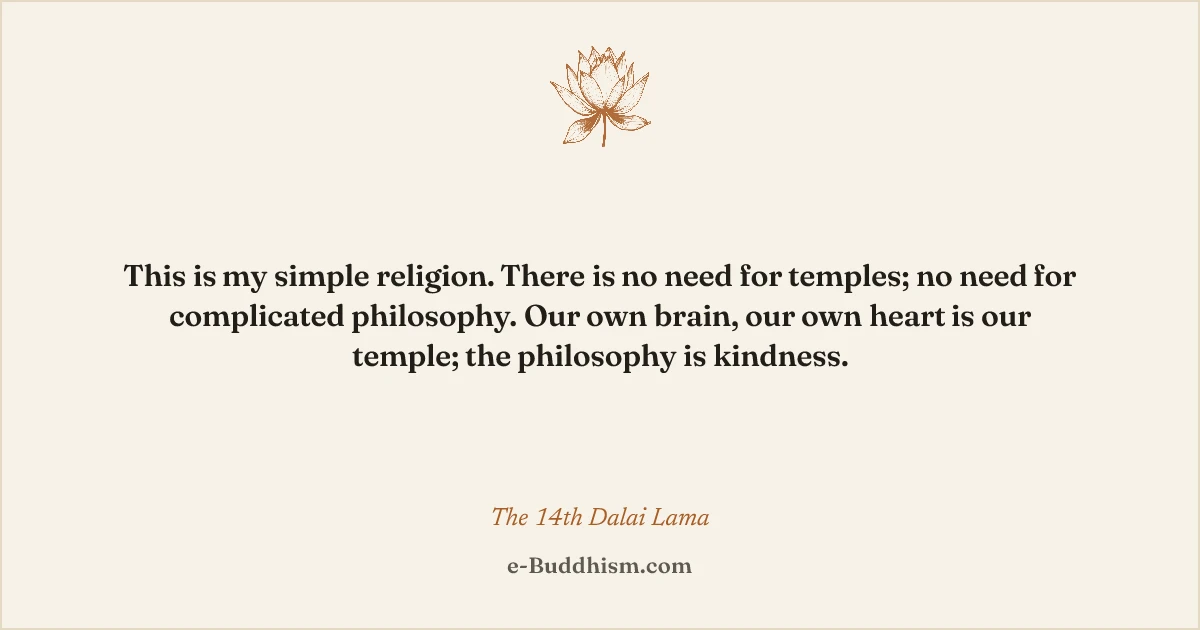
“This is my simple religion. There is no need for temples; no need for complicated philosophy. Our own brain, our own heart is our temple; the philosophy is kindness.” — The 14th Dalai Lama
What it means
The line performs a quiet relocation. The “temple” — the place where the sacred is met — is moved from a building to “our own brain, our own heart.” The “philosophy” — the system that is supposed to make sense of life — is reduced to a single word: kindness. In one breath, the apparatus of religion is set aside, and what it was all for is held up instead.
It is worth being clear about who is saying this. This is not a sceptic dismissing religion from the outside; it is a Buddhist monk, immersed in one of the most elaborate philosophical and ritual traditions on earth. That is exactly what gives the sentence its weight. He is not rejecting temples and philosophy — he lives by them — but insisting on their purpose. They are means; a good heart is the end. When everything else is stripped away, kindness is what is left, and it is enough.
This is also why his message travels so far beyond Buddhism: kindness asks no prior belief. Anyone, of any faith or none, can take up “my simple religion” today.
Where it comes from — and whose words they are
The wording appears in The Dalai Lama: A Policy of Kindness, an anthology of his writings and talks edited by Sidney Piburn (Snow Lion, 1990). The “religion is kindness” idea recurs across his life in slightly different forms; this is one of its best-known expressions. We attribute it, rightly, to the Dalai Lama — not to the Buddha. It grows from the heart of Buddhist ethics, but the voice is his.
Why it matters
The Dalai Lama is the foremost living teacher of Tibetan Buddhism, and compassion is the centre of everything he teaches — the natural partner of the loving-kindness the Buddha taught and of the whole of Buddhist ethics. It also speaks to a genuine puzzle this site explores: whether Buddhism is a religion or a philosophy at all.
Browse more sourced lines in our Buddhist quotes collection.
Frequently asked questions
Did the Dalai Lama really say 'my religion is kindness'?
Yes — it is a genuine and recurring theme of his, expressed in several forms over the years. This wording appears in the anthology 'The Dalai Lama: A Policy of Kindness' (Snow Lion, 1990). We attribute it to him, not to the Buddha; it is his own way of distilling Buddhist ethics into a single accessible idea.
What does he mean by it?
That what matters most is not ritual or elaborate metaphysics but a good heart. 'Our own brain, our own heart is our temple' relocates the sacred from buildings and doctrines into one's own mind and conduct. For the Dalai Lama, kindness and compassion are the practical core that any person, religious or not, can live by.
Is he dismissing temples and philosophy?
Not really — he is a monk steeped in a vast philosophical tradition and lives a deeply ritual life. He is making a point of priority: temples and philosophy are means, and the end they serve is a kind heart. Stripped to its simplest, he is saying, that end is what religion is finally for.
Sources
- His Holiness the 14th Dalai Lama, in 'The Dalai Lama: A Policy of Kindness,' ed. Sidney Piburn (Snow Lion, 1990), p. 52.