The Art of Letting Go in Buddhism (Without Going Numb)
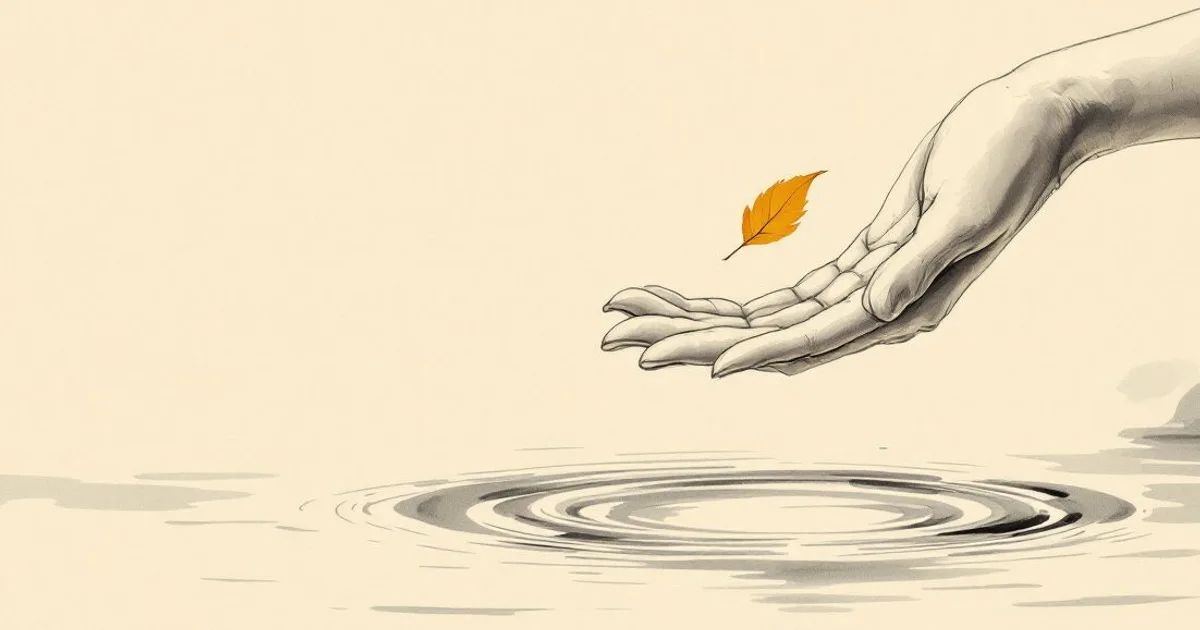
“Letting go” is the most quoted and most misunderstood phrase in popular Buddhism. It does not mean not caring, going numb, or cutting people off. It means releasing the craving that, according to the second noble truth (SN 56.11), turns ordinary change into suffering — the grasping demand that good things never end and that we stay permanently in control. The Buddha pushed this so far that he taught letting go even of his own teaching, like a raft you set down once it has carried you across (MN 22).
First, What Letting Go Is Not
Because the phrase gets used so loosely, it helps to clear away what it doesn’t mean before saying what it does.
- It is not going numb. Letting go is not anaesthesia. You are not trying to stop feeling grief, love, or delight — those are the texture of a human life, and the path does not ask you to amputate them.
- It is not cold detachment. A heart that has stopped caring is not free; it is just shut. The tradition praises equanimity, which is steadiness that holds love inside it — not indifference, which holds nothing.
- It is not giving up or passivity. Letting go is not a shrug. You can pour yourself fully into work, relationships, and causes while releasing the clutch on the outcome.
- It is not suppression. Shoving a feeling down is the opposite of letting it go. You can only release what you’ve first been willing to feel.
Get these confusions out of the way and the real teaching comes into focus: the thing to be released is not the world, and not your love for it, but the grasping.
What Is Actually Released: Craving
The Four Noble Truths lay it out with almost surgical clarity. The first names suffering; the second locates its origin in craving (taṇhā) — the thirst for things to be other than they are. The third truth, cessation, is then defined in SN 56.11 as the “fading and cessation, renunciation, relinquishment, release, and letting go of that very craving.” Letting go is not a vague mood in Buddhism. It is the precise mechanism by which suffering ends: where the grasping fades, the suffering built on it has nothing left to stand on.
This is why letting go and caring are not opposites. The craving and the care are two different things, even though they usually arrive tangled together. You can love a person completely and still release the craving to control them, to keep them unchanged, to be guaranteed they’ll never leave. Pull the craving out and what remains is not less love — it is love with its claws retracted.
The Raft You Put Down
The Buddha’s most striking image for letting go appears in the Alagaddupama Sutta (MN 22). Imagine, he says, a traveller who comes to a wide river. The near bank is dangerous; the far bank is safe. There’s no bridge, so he gathers grass and branches, binds a raft, and paddles across. The raft has served him perfectly. Now — what should he do with it?
He shouldn’t, the Buddha observes, think this raft has been so useful, I’ll carry it on my back wherever I go. He should haul it up on the shore, or push it back into the stream, and walk on unburdened. The raft, he says, is “for crossing over, not for holding onto.” And then comes the radical turn: the teaching itself is like that raft. Even the Dharma is something to use and then release — and if even the path is to be held lightly, how much more lightly should we hold our opinions, our grudges, our plans, our image of how life was supposed to go.
In the same discourse the Buddha warns that grasping his teaching wrongly is like seizing a water-snake by the coils: handled clumsily, even something good will turn and bite you. Clinging spoils what it clings to — including spiritual things. People can grip “non-attachment” itself as one more possession. The raft is a standing reminder that the point was never to own anything, even wisdom; the point was to get free.
The Deepest Letting Go: “Not Mine”
MN 22 also points to the most fundamental release of all. The Buddha invites us to regard each part of experience — body, feelings, perceptions, mental habits, awareness itself — with the same refrain: “This is not mine, this is not my self, this is not what I am.” This is the teaching of not-self (anattā), and it is easy to misread, so let’s be careful: it is not a denial that you exist, and it is not nihilism. It is the loosening of the reflex by which we wrap our identity around passing things and then suffer when they change.
In everyday terms, this is the move from my humiliation, my loss, my failure — each my a tiny hook of ownership — toward simply seeing a feeling arise and pass without building a permanent self around it. It is subtle, and it deepens over a lifetime of practice rather than in an afternoon. But even a little of it is a great relief: the weight we carry is largely the weight of mine.
Letting Go Is a Practice, Not a Trophy
It would be a mistake to imagine letting go as a single heroic act after which you are Done. Nobody lets go once. The grip returns — around a worry, an outcome, a slight — and you open the hand again, and again. The skill is not in achieving some final non-attachment; it is in noticing the clench sooner and loosening it more gently each time.
The everyday version is a felt sense of holding life more lightly: enjoying things without clutching, loving people without trying to own them, meeting change — anicca, impermanence — as the nature of things rather than a personal insult. This is the near twin of acceptance: where letting go releases the grip, acceptance allows what is already here without firing the second arrow of resistance. You can practise it in absurdly small ways: releasing the need to win a pointless argument, letting a plan change without spiralling, unclenching around a worry at 3am. None of these is dramatic. All of them are the same gesture the raft simile points to, made at human scale.
The Zen traditions are especially fond of this immediacy. A well-known Zen teaching story tells of two monks who help a woman across a muddy river; hours later one is still fuming that they touched her at all, and the other says, in effect, I set her down at the river — are you still carrying her? Whatever its origins, the story lands the point exactly: most of our suffering is the carrying we keep doing long after the moment has passed.
A Small Practice to Begin
Try the open hand. The next time you notice yourself gripping — a need to be right, a plan that just changed, a worry on a loop — pause and, if it helps, literally open your hand, palm up. Silently note what you’re clutching, and say to yourself: I can hold this more lightly. You’re not throwing anything away or pretending not to care. You’re just releasing the white-knuckle grip, once, knowing you’ll do it again tomorrow.
That is the art of letting go — less a grand renunciation than a small, repeatable kindness to yourself. For the wider practice it belongs to, see Buddhism in everyday life; for the craving it releases, the Four Noble Truths; for how this same loosening transforms how we love, our guide to love versus attachment; for holding the result lightly when you have a choice to make, making decisions with Buddhist wisdom; and for the contentment that opens up once the grip relaxes, Buddhism and happiness.
Frequently asked questions
What does 'letting go' actually mean in Buddhism?
It means releasing craving — the grasping demand that pleasant things never end, that unpleasant things vanish, and that we stay permanently in control. The second noble truth (SN 56.11) names this craving as the cause of suffering, so letting go of it is the cause of relief. It does not mean not caring, going numb, or cutting people off.
Isn't letting go the same as detachment or not caring?
No, and this is the most common misunderstanding. You are asked to let go of the grasping, not the love. In fact, releasing the clutch of craving usually lets you care more freely, not less — you can love people without trying to own them, and engage fully without depending on a particular outcome. Cold indifference is a different thing entirely, and the tradition does not praise it.
What is the raft simile?
In the Alagaddupama Sutta (MN 22) the Buddha compares his teaching to a raft built to cross a river. Once you reach the far shore, you don't hoist the raft onto your back and carry it around — you set it down, grateful, and walk on. The teaching is 'for crossing over, not for holding onto.' Even the Dharma is to be used and then released, not clung to.
How is letting go different from giving up?
Giving up abandons the action; letting go releases the grasping around it. You can work wholeheartedly for something and still hold the result lightly, without your peace depending on it. In fact letting go of the white-knuckle craving for a particular outcome often makes you act more clearly and persist more steadily, because fear isn't running the show.
How do I practise letting go in daily life?
In small, repeatable ways: releasing the need to win a pointless argument, letting a plan change without spiralling, opening your hand around a worry instead of gripping it. Letting go is not a single heroic act but a gesture you make again and again — each time you notice the clench of 'it must be this way' and choose to loosen it.
Sources
- Alagaddupama Sutta (MN 22), 'The Water-Snake Simile' / 'The Simile of the Raft' — SuttaCentral; Access to Insight (trans. Ṭhānissaro Bhikkhu)
- Dhammacakkappavattana Sutta (SN 56.11), 'Setting the Wheel of Dhamma in Motion' — SuttaCentral; Access to Insight