Who Was the Buddha? The Life Story of Siddhartha Gautama
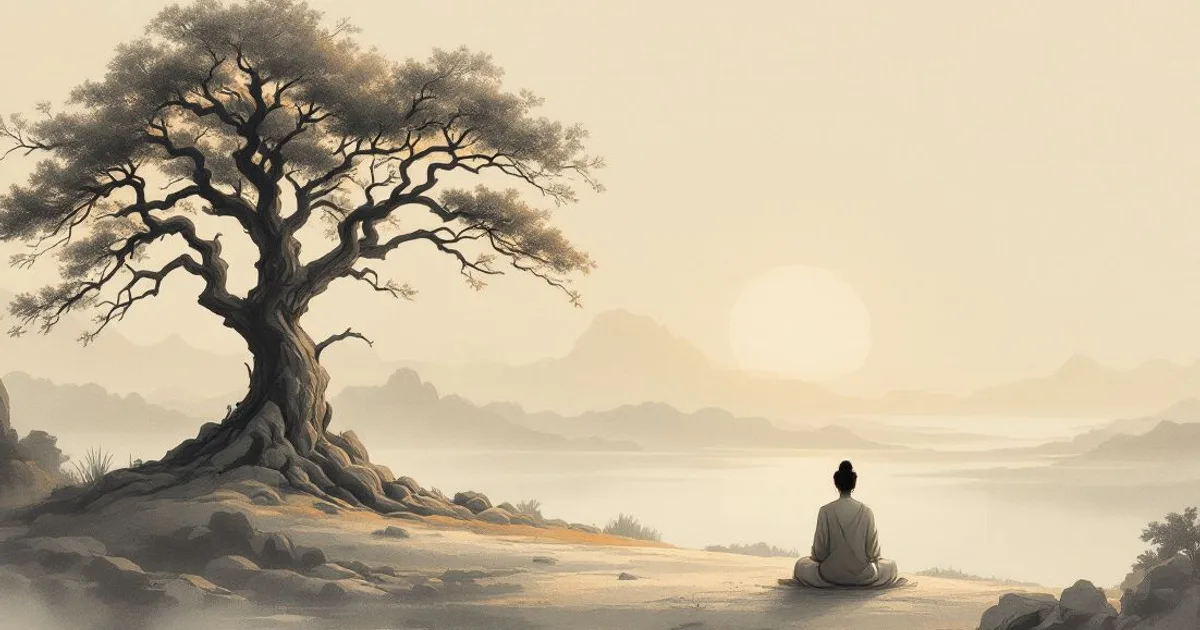
The Buddha was Siddhārtha Gautama (Pali: Siddhattha Gotama), a teacher who lived in the eastern Ganges plain of ancient India roughly 2,500 years ago. “Buddha” is not a name but a title — “the awakened one.” Born into a ruling family, he left it to seek an end to suffering, said he found it, and spent the rest of his life teaching the path he had discovered.
- Also known as
- Siddhārtha Gautama (Sanskrit) · Siddhattha Gotama (Pali) · Shakyamuni · the Tathāgata
- Born
- Lumbini, in present-day Nepal — into the Shakya clan
- Died
- Kushinagar (Kusinārā), northern India, at around age 80
- Lived
- Traditionally c. 563–483 BCE; many modern scholars favour c. 480–400 BCE
- Known for
- Teaching the Four Noble Truths and the Middle Way — the foundation of Buddhism
”The Buddha” Is a Title, Not a Name
It is worth getting this clear at the start, because it shapes everything else. Buddha is a Sanskrit and Pali word meaning “awakened” or “enlightened.” When the texts call someone “a buddha,” they mean a person who has woken up fully to the way things are and is free of the craving and confusion that cause suffering.
The man we usually mean by “the Buddha” had the personal name Siddhārtha Gautama. He belonged to the Shakya people, so he is also called Shakyamuni — “the sage of the Shakyas.” In the discourses he most often refers to himself as the Tathāgata, a difficult term usually rendered “the thus-gone” or “the thus-come one.”
This matters because it answers one of the most common questions newcomers have: the Buddha is not presented in the earliest texts as a god, a prophet, or a savior. He is presented as a human being who, through his own effort, saw something true and worked out a method anyone could follow. As we will see, later traditions came to understand his nature in richer and sometimes very different ways — but the starting point of the tradition is a human teacher.
When and Where Did the Buddha Live?
The Buddha lived and taught in the river plains of northeastern India, in and around the small republics and kingdoms of the Ganges valley — the region of modern Bihar and Uttar Pradesh, near the border with Nepal.
His dates are genuinely uncertain, and an honest guide should say so. For centuries the traditional reckoning placed his life at about 563–483 BCE. Since the late twentieth century, however, many scholars have argued for a later range, placing his death closer to 400 BCE and his birth around 480 BCE. The two pictures differ by roughly a century. What they agree on — and what the texts themselves report — is that he lived to about eighty years old. Anyone who gives you a single confident birth year is overstating what the evidence allows.
The world he lived in was changing fast: new cities, trade, coinage, and a ferment of wandering teachers and philosophies competing to explain life and death. The Buddha was one of many samaṇas — renunciants who had left ordinary society to seek liberation. What distinguished him was the path he taught and the community he left behind.
What the Earliest Texts Actually Say
Most popular versions of the Buddha’s life are vivid and detailed — a sheltered prince, a series of fateful chariot rides, a dramatic midnight escape. It is important to know where these details come from, because the earliest layer of the tradition is far more restrained.
In the Ariyapariyesanā Sutta (“The Noble Search,” MN 26), the Buddha gives a first-person account of his own quest. It is strikingly plain. He says that while still young, “a black-haired young man endowed with the blessings of youth,” and while his parents wept and wished otherwise, he shaved his head, put on the ochre robe, and went forth from home into homelessness, seeking the highest peace.
He then describes studying under two named teachers. From Āḷāra Kālāma he learned to reach the meditative attainment called “the dimension of nothingness”; from Uddaka Rāmaputta, the still subtler “dimension of neither perception nor non-perception.” He mastered what each could teach — and concluded that neither led all the way to the end of suffering. So he left them and continued alone until he awakened.
That is essentially the whole of the canonical autobiography: he left home, sought teachers, found their attainments incomplete, and broke through on his own. There are no palace miracles in it and no four chariot rides. The elaborate biography most people know was assembled later, in commentarial and poetic literature, to fill in and dramatize this spare frame. Both layers are part of the tradition — but a trustworthy account keeps them distinct. For what history can and cannot establish about the man behind the legend, see the historical Buddha; for the most famous embellishment of all — the auspicious bodily signs read on the newborn — the thirty-two marks of a great man; and for the much-loved stories of his previous lives, the Jātaka tales.
The Life Story: From Privilege to Awakening
With that distinction in mind, here is the traditional life story as the later tradition tells it, with the canonical anchors noted along the way.
Birth and early life
Traditional accounts hold that Siddhārtha was born at Lumbini, near the Shakya capital of Kapilavatthu, to Suddhodana, a leader of the Shakya clan, and his wife Māyā. (Māyā died within days of the birth; the boy was raised by her sister Mahāpajāpatī, who would herself, decades later, become the first ordained Buddhist nun.) The familiar stories of a miraculous birth and a sage’s prophecy that the child would become either a great king or a great holy man belong to this later biographical literature, not to the earliest discourses. (For the birthplace, the traditional account, and what history confirms, see the birth of the Buddha at Lumbini.)
The texts do preserve one telling memory in the Buddha’s own voice: he describes having been raised in great refinement and comfort, with every luxury — and yet, reflecting that he too was subject to ageing, sickness, and death like everyone else, the “intoxication” of youth and health drained away. Whatever the precise facts of his upbringing, the tradition is consistent that he began in privilege and found it could not answer the deepest problem of human life.
The going forth
The most famous version of his turn toward the spiritual life is the story of the Four Sights: a sheltered prince ventures out and encounters, for the first time, an old person, a sick person, a corpse, and finally a serene wandering ascetic — and resolves to seek a way beyond suffering. This dramatic episode comes from later biographical sources; the early texts give the quieter reflection on ageing, sickness, and death described above.
What the early texts do state directly is his age. In the Mahāparinibbāna Sutta (DN 16), near the end of his life, the Buddha tells the wanderer Subhadda that he went forth at twenty-nine and had now been a seeker for more than fifty years — the source of the traditional reckoning that he renounced home life at twenty-nine and died at around eighty. (For this decisive departure — the history and the legend — see the Great Renunciation.)
The years of striving
After leaving home, the traditional account gives roughly six years of intense seeking. This is the period of the two teachers from MN 26, followed by a turn to severe self-mortification — extreme fasting and ascetic practices pursued in the company of five fellow seekers. The early texts describe him pushing this to the edge of death and concluding that punishing the body did not free the mind. (For the two teachers, the austerities, and the turn that followed, see the Buddha’s ascetic years.)
That conclusion produced one of his most important teachings: the Middle Way, a path that avoids both indulgence in pleasure and pointless self-torment. He took food again, his five companions left him in disgust, and he sat down to meditate with a settled mind.
The awakening
Traditional accounts place his awakening under a tree — later called the Bodhi tree (“awakening tree”) — at the site now known as Bodh Gaya. According to the tradition he was about thirty-five. The tradition tells how, through that final night, he withstood the assault of Māra — the personification of temptation and death — before his breakthrough at dawn.
What “awakening” means is the heart of the matter, and the texts are more interested in this than in the scenery. To be a buddha is to have uprooted craving and ignorance completely, to have seen directly how suffering arises and how it ends, and so to be free — no longer bound to the round of rebirth. The content of that insight is what he would spend forty-five years explaining: above all, the Four Noble Truths. (For the night of awakening itself — the three knowledges of the early texts, and what he realized — see our deep dive on the Buddha’s enlightenment.)
Setting the wheel in motion
After his awakening, the Buddha sought out the five companions who had abandoned him and gave his first teaching to them at the Deer Park at Isipatana, near Varanasi (modern Sarnath). This discourse, the Dhammacakkappavattana Sutta (“Setting the Wheel of Dhamma in Motion,” SN 56.11), lays out the Middle Way and the Four Noble Truths: that there is suffering, that it has an origin in craving, that it can cease, and that a path leads to its cessation. The tradition marks this moment as the founding of the Buddhist teaching in the world. (For the first sermon in full — the five ascetics and the founding of the Sangha — see the first sermon; for the framework it taught, The Four Noble Truths.)
Forty-five years of teaching
From then until his death, the Buddha walked and taught across the Ganges plain in a forty-five-year teaching career. He gathered a community — the Sangha — of monks and, later, nuns, led by chief disciples such as Sāriputta, Mahāmoggallāna, and his devoted attendant Ānanda, and taught lay followers from every level of society: kings and merchants, farmers and outcastes. The discourses show him adjusting his teaching to the person in front of him, debating other teachers, and building an order designed to outlast him — even weathering an attempted schism led by his ambitious cousin Devadatta. What he refused to do, repeatedly, was set himself up as an indispensable authority: the teaching, he insisted, was something each person had to verify and walk for themselves. (For how that teaching spread across Asia in the centuries after his death, see how Buddhism spread.)
The Parinibbāna
The Mahāparinibbāna Sutta (DN 16) records his final months and death. Old and ill, he travelled to Kusinārā (Kushinagar), lay down between two sal trees in the lion’s posture, and gave his last instructions to the assembled monks. The tradition remembers his final words as a charge to keep practising — that all conditioned things pass away, and that they should strive on with diligence. He died at around eighty. His passing is called the parinibbāna, the “final nibbāna” of one who will not be reborn. (For his last days, last words, and what parinirvana means, see the death of the Buddha. His birth, his awakening, and his passing are remembered together each year at Vesak, the most important Buddhist festival.)
A Timeline of the Buddha’s Life
The ages below follow the traditional reckoning anchored in DN 16; the absolute dates are approximate and disputed (see above).
- Birth — at Lumbini, into the Shakya clan (traditionally c. 563 BCE; many scholars favour c. 480 BCE).
- Age 29 — Goes forth from home into homelessness, seeking liberation (DN 16; MN 26).
- ~6 years of striving — Trains under Āḷāra Kālāma and Uddaka Rāmaputta, then practises severe asceticism and abandons it for the Middle Way (MN 26).
- Age ~35 — Awakening at Bodh Gaya (traditional account).
- Soon after — First teaching at the Deer Park, Isipatana, to the five companions (SN 56.11).
- 45 years — Teaches across the Ganges plain and establishes the Sangha.
- Age ~80 — Parinibbāna at Kusinārā, between two sal trees (DN 16) (traditionally 483 BCE; many scholars favour c. 400 BCE).
Why the Buddha Still Matters
The Buddha’s claim was unusual and remains his central appeal: that the deepest human problem — the dissatisfaction, loss, and unease woven through even good lives — has a cause, and that the cause can be removed. He did not ask to be believed on faith or worshipped for rescue. He offered a diagnosis and a method, and invited people to test it in their own experience.
That is why his teaching travels so well across cultures and centuries, and why it speaks to people with no interest in religion at all. If you are new to all of this, the gentlest doorway is our guide to Buddhism for beginners, and the single most important thing he taught is unpacked in the Four Noble Truths.
How Different Traditions Understand the Buddha
One of the most important things to know — and something many introductions flatten — is that Buddhists do not all understand the Buddha in the same way. The differences are real and worth respecting.
-
Theravāda, the tradition closest to the early texts, generally regards the Buddha as a human being: an extraordinary teacher who reached awakening, who is now fully “gone” in parinibbāna, and who therefore cannot be petitioned or prayed to. What remains is the Dhamma he taught. Reverence is real, but it is gratitude and inspiration, not worship of a living presence.
-
Mahāyāna traditions developed a much larger view. Here the historical Gautama is often seen as one appearance of a far more profound reality. The doctrine of the “three bodies” (trikāya) distinguishes the physical Buddha who walked in India from his ultimate, timeless nature; alongside him stand other, transcendent buddhas and great bodhisattvas. Many Mahāyāna schools also teach that the potential for buddhahood — “buddha-nature” — is present in all beings.
-
Vajrayāna (the tantric Buddhism of Tibet and the Himalayas) builds on the Mahāyāna view and adds practices in which enlightened buddhas and deities are met through visualization, devotion, and ritual under a qualified teacher.
These are not minor variations of emphasis; they are different understandings of what a buddha ultimately is. The honest summary is this: the earliest texts present a human teacher who awakened and died, while later traditions came to see in him something cosmic and ever-present. One thing nearly all traditions share, though, is a forward look: a future buddha, Maitreya, is awaited in a distant age when the present teaching has faded from the world. To learn how these traditions arose and diverged, see our guide to the branches of Buddhism.
Frequently asked questions
Was the Buddha a real person?
Most scholars accept that a historical teacher named Siddhārtha Gautama lived in the eastern Ganges plain of ancient India and founded what became Buddhism. The earliest texts preserve a spare, first-person account of his quest for awakening (Ariyapariyesanā Sutta, MN 26), though his exact dates are debated.
Is the Buddha a god?
No. 'Buddha' is a title meaning 'the awakened one.' The earliest texts present him as a human being who awakened to the truth through his own effort and then taught a path others could follow — not a creator, a deity, or someone to be prayed to for salvation. How later traditions regard him varies.
When did the Buddha live?
Traditionally he is dated to roughly 563–483 BCE. Many modern scholars now place his life about a century later, with his death closer to 400 BCE. Both reckonings agree he lived to around eighty and that the date remains genuinely uncertain.
What was the Buddha's real name?
Siddhārtha Gautama in Sanskrit, or Siddhattha Gotama in Pali. He is also called Shakyamuni — 'sage of the Shakyas,' his clan — and often refers to himself in the texts as the Tathāgata. 'The Buddha' is a title he earned at his awakening, not a birth name.
Where was the Buddha born and where did he die?
Traditional accounts place his birth at Lumbini, in present-day Nepal, and his death at Kushinagar (Kusinārā) in northern India, lying between two sal trees (Mahāparinibbāna Sutta, DN 16).
What did the Buddha teach first?
His first discourse, given at the Deer Park at Isipatana near Varanasi to five former companions, set out the Middle Way and the Four Noble Truths (Dhammacakkappavattana Sutta, SN 56.11).
Sources
- Ariyapariyesanā Sutta (MN 26), 'The Noble Search' — SuttaCentral; Access to Insight (trans. Ṭhānissaro Bhikkhu)
- Mahāparinibbāna Sutta (DN 16), 'Last Days of the Buddha' — SuttaCentral; Access to Insight (trans. Sister Vajirā & Francis Story)
- Dhammacakkappavattana Sutta (SN 56.11), 'Setting the Wheel of Dhamma in Motion' — SuttaCentral; Access to Insight