Pure Land Buddhism and the Practice of Amitabha
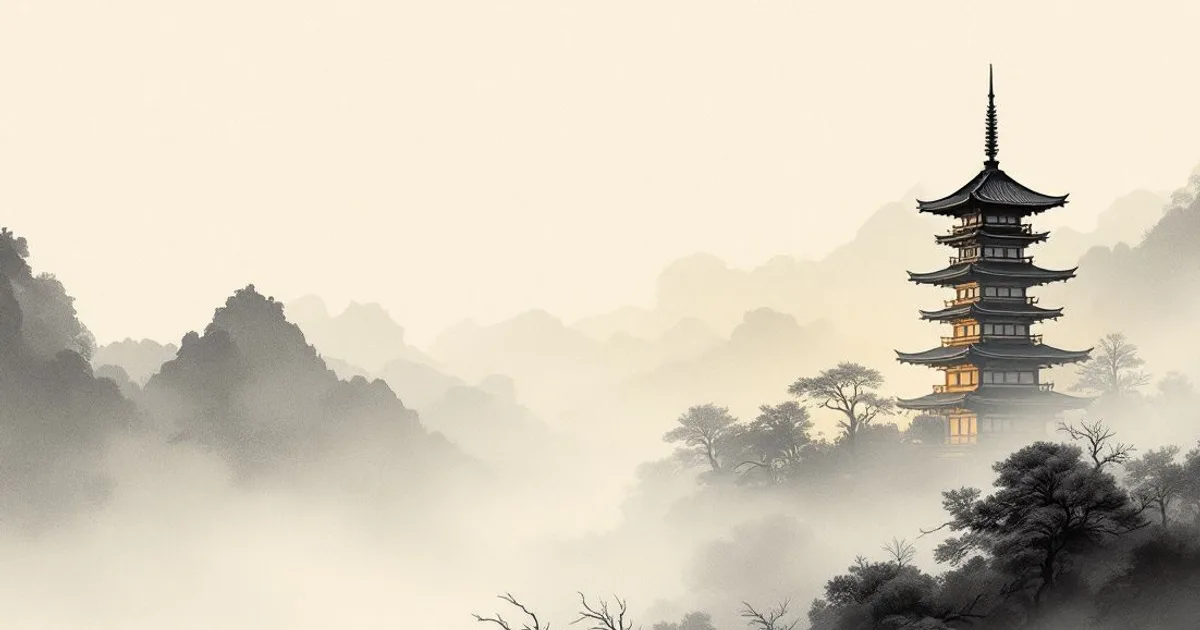
Pure Land Buddhism is the great devotional stream of East Asian Mahayana — a path of faith rather than strenuous self-effort. It centres on the Buddha Amitabha (Amida), the “Buddha of Infinite Light,” and his Pure Land, a realm where awakening is assured. Its practice is simple and open to everyone: to recite Amitabha’s name with sincere devotion, and so be reborn there.
The short answer
Encyclopaedia Britannica describes Pure Land as the “devotional cult of the Buddha Amitabha — ‘Buddha of Infinite Light’” and “one of the most popular forms of Mahayana Buddhism in eastern Asia.” Its central promise is striking in its accessibility: “rebirth in Amitabha’s Western Paradise, Sukhavati, known as the Pure Land, or Pure Realm, is ensured for all those who invoke Amitabha’s name with sincere devotion.” The practice that does this is the nembutsu — the recitation of Amitabha’s name. And the idea beneath it is what sets Pure Land apart from most of Buddhism: a reliance on the saving power of a buddha rather than on one’s own effort — an “easy path” held open to ordinary people who could never manage the rigorous one. (Unfamiliar terms are in the glossary.)
In more depth
Amitabha and his Pure Land
At the centre of the tradition stands Amitabha (Sanskrit for “Infinite Light”; in Japanese, Amida) — a transcendent buddha of the kind the Mahayana developed in abundance. The scriptures tell that, countless ages ago, as the bodhisattva Dharmakara, he made a series of great vows, and resolved that if he attained buddhahood he would establish a “Pure Land” — Sukhavati, the “Western Paradise” — into which any being who called on him in faith would be reborn. A Pure Land is not an eternal heaven of reward but an ideal environment for practice: a realm so free of the obstacles and distractions of ordinary existence that those reborn there are assured of progressing all the way to full awakening. The Pure Land path, then, does not bypass enlightenment; it secures the conditions for it.
The practice: the nembutsu
The act that opens this door is wonderfully simple. The nembutsu (Japanese; in Chinese, nianfo) is the recitation of Amitabha’s name — Namu Amida Butsu, “homage to Amida Buddha.” Where other paths ask for years of meditative discipline or scholarly mastery, Pure Land asks for this: that one call upon Amitabha with a sincere and trusting heart. Britannica notes that the great Japanese teacher Honen “stressed the recitation of nembutsu as the one act necessary to gain admittance to the Pure Land.” Recited aloud many times a day, or held in deep faith, the nembutsu is a practice equally available to the monk and the labourer, the scholar and the illiterate — and that universality is precisely the point. (It is the best-known example of Buddhist chanting as devotional recitation, the great companion to the sutra and paritta chanting of other schools.)
Other-power and self-power
Here lies the theological heart of Pure Land, and its boldest move. Most forms of Buddhism rely on what the tradition calls jiriki, “self-power” — your own sustained effort along the path of ethics, meditation, and wisdom. Pure Land relies instead on tariki, “other-power” — the compassionate power of Amitabha’s vow to carry the devotee across. Honen reached this conviction out of a clear-eyed humility, teaching, in Britannica’s summary, that “most men were, like himself, incapable of obtaining buddhahood on this earth through their own efforts… but were dependent on Amida’s help.” The teaching belongs to an old Buddhist sense that we live in a degenerate age, far from the Buddha’s time, when the heroic path is beyond most ordinary people; against that bleak backdrop, Pure Land offers a path of grace. This is the most devotional and faith-filled form of Buddhism — and the reason it can look, from outside, very like theistic religion, a resemblance we examine in our guide to whether Buddhists pray.
From China to Japan
Pure Land devotion grew from Indian roots — the Sukhavati sutras — and developed powerfully in China, shaped by teachers such as Tanluan and Shandao; Britannica records that “it has survived as an independent sect in China.” But it reached its fullest flowering in Japan. “The Pure Land teaching was transmitted to Japan,” Britannica notes, and “by the 12th–13th century had separated as a distinct sect.” There Honen founded the Pure Land school (Jodo-shu), and his disciple Shinran founded Jodo Shinshu — “True Pure Land” Buddhism, often called the Shin school, which became one of the largest Buddhist denominations in Japan. Shinran pressed other-power to its limit: “According to the Shin school,” Britannica observes, “faith alone is sufficient.” On this radical reading, even the nembutsu is less a work that earns rebirth than an expression of grateful trust in a salvation already freely given.
Pure Land among the traditions
Pure Land is a form of Mahayana Buddhism, sharing the bodhisattva ideal, the teaching of emptiness, and the ultimate goal of buddhahood. What distinguishes it is its method and mood: where Zen sits in silent self-reliance, Pure Land calls out in trust to the compassion of a buddha. It is sometimes underrated by Westerners drawn to the austere, “do-it-yourself” image of Buddhism — yet by sheer numbers it is among the most widely practised forms of the religion on earth, a path of humility and devotion for countless ordinary people. And it carries a profound suggestion that the self-reliant traditions can lose sight of: that awakening may come not only through heroic personal effort, but through the letting-go of trust — through surrendering into a compassion far larger than oneself. (For the full map of the traditions, see the branches of Buddhism.)
Frequently asked questions
What is Pure Land Buddhism?
Pure Land Buddhism is the great devotional stream of Mahayana Buddhism in East Asia. Encyclopaedia Britannica calls it the 'devotional cult of the Buddha Amitabha' and 'one of the most popular forms of Mahayana Buddhism in eastern Asia.' Rather than relying on strenuous self-effort, it centres on faith in the Buddha Amitabha and the recitation of his name, by which a devotee gains rebirth in his Pure Land — a realm where awakening is assured.
What is the nembutsu?
The nembutsu (Japanese; Chinese nianfo) is the recitation of Amitabha's name — 'Namu Amida Butsu,' meaning 'homage to Amida Buddha.' It is the central Pure Land practice. According to Britannica, the teacher Honen 'stressed the recitation of nembutsu as the one act necessary to gain admittance to the Pure Land.' Simple and available to anyone, it is the heart of the tradition.
What is Amitabha's Pure Land?
It is Sukhavati, the 'Western Paradise,' the realm of Amitabha — the 'Buddha of Infinite Light.' Britannica explains that 'rebirth in Amitabha's Western Paradise, Sukhavati, known as the Pure Land… is ensured for all those who invoke Amitabha's name with sincere devotion.' It is not an eternal heaven but an ideal place for practice, where the conditions for reaching full awakening are assured.
What is the difference between 'self-power' and 'other-power'?
Most Buddhist paths rely on 'self-power' (jiriki) — your own effort in ethics, meditation, and wisdom. Pure Land relies on 'other-power' (tariki) — the saving power of Amitabha's vow. Honen taught that most people are, in Britannica's words, 'incapable of obtaining buddhahood on this earth through their own efforts… but were dependent on Amida's help.' Pure Land is the great other-power path of Buddhism.
Is Pure Land Buddhism like worshipping a god?
It looks the most theistic of all Buddhist traditions, and the resemblance is real — but Amitabha is a buddha, an awakened being, not an eternal creator God. Rebirth in his Pure Land is a step toward one's own awakening, not an eternal paradise as a final reward. We explore exactly this question in our guide to whether Buddhists pray.
Sources
- Pure Land Buddhism (entry), Encyclopædia Britannica