“If There's a Remedy, Why Be Unhappy?” — Shantideva 6.10
One of the most-shared “Buddha” quotes on worry was not, in fact, spoken by the Buddha. The lines — if a trouble can be fixed, worry is needless; if it cannot, worry is useless — come from Shantideva, an 8th-century Indian monk, in his classic poem The Way of the Bodhisattva. The teaching is thoroughly Buddhist; the words are his. Here is the real verse, its meaning, and its source.
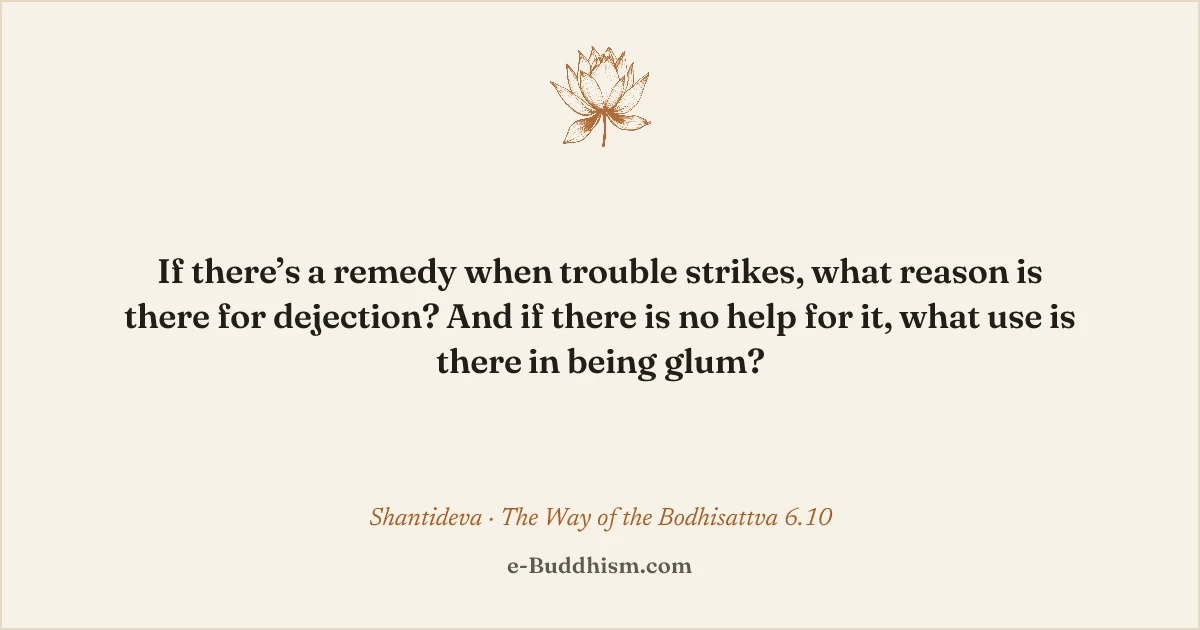
“If there’s a remedy when trouble strikes, what reason is there for dejection? And if there is no help for it, what use is there in being glum?” — Shantideva, The Way of the Bodhisattva 6.10 (trans. Padmakara Translation Group)
What it means
The verse is a small, clean piece of logic aimed straight at worry. Face any difficulty and there are only two possibilities. Either something can be done about it — in which case dejection is unnecessary; turn that energy into the remedy. Or nothing can be done — in which case dejection is pointless; it changes nothing and merely adds a second layer of suffering on top of the first.
Notice what the verse is not saying. It is not “don’t care,” and it is not a trick for suppressing difficult feelings. It comes from Shantideva’s chapter on patience (kṣānti), where the aim is to stop our minds from compounding pain with agitation. The verse simply removes the third option we usually choose — to neither fix the problem nor accept it, but to stew. Seen clearly, that option helps nothing.
This is also why it is such a practical companion in moments of anxiety: it doesn’t deny the trouble, it just asks the honest question — is there something I can do right now, or not? — and points out that gloom is the one response that never helps either way.
Where it comes from — and who really said it
The verse is 6.10 of the Bodhicaryāvatāra (“The Way of the Bodhisattva”), by Shantideva, an 8th-century monk of the great monastic university of Nālandā. The poem is one of the most loved works of Mahāyāna Buddhism and a cornerstone text in Tibetan Buddhism, where it is studied and recited to this day. The wording above is the Padmakara Translation Group’s; the Oxford translation by Crosby and Skilton renders it, “If there is a solution, then what is the point of dejection?”
Because the thought is so neat and so obviously wise, it gets passed around online as the Buddha’s — often as “If a problem can be solved…”. It is genuinely Buddhist wisdom, just from a different voice, more than a millennium after the Buddha. Crediting it correctly costs nothing and keeps the record honest.
How to use it
The next time worry takes hold, try Shantideva’s two questions in order: Can I do something about this? If yes, the verse hands the worry back to you as action. If no, it invites the harder, freer practice of letting go of what was never in your hands.
Browse more sourced lines — including a note on why so many “Buddha quotes” are misattributed — in our Buddhist quotes collection.
Frequently asked questions
Did the Buddha say 'if a problem can be solved, why worry'?
No. This is one of the most commonly misattributed 'Buddha' quotes. It comes from Shantideva, an 8th-century Indian Buddhist monk, in his poem the Bodhicaryāvatāra ('The Way of the Bodhisattva'), verse 6.10 — written more than a thousand years after the Buddha. The teaching is Buddhist, but the words are Shantideva's, not the Buddha's.
What does the quote mean?
It is a simple argument against pointless worry. If a difficulty can be fixed, then anxiety is unnecessary — just fix it. And if it genuinely cannot be fixed, then anxiety is useless — it changes nothing and only adds suffering. Either way, dejection helps nothing, so why give in to it?
What is the popular 'If a problem can be solved…' version?
A smoothed paraphrase — 'If a problem can be solved there is no need to worry, and if it can't be solved, worrying will do no good' — captures the meaning but is not the literal verse. The wording above is from the Padmakara translation; the Crosby–Skilton edition reads, 'If there is a solution, then what is the point of dejection? What is the point of dejection if there is no solution?'
Sources
- Shantideva, The Way of the Bodhisattva (Bodhicaryāvatāra) 6.10, trans. Padmakara Translation Group (Shambhala, rev. ed. 2006).
- Śāntideva, The Bodhicaryāvatāra, trans. Kate Crosby & Andrew Skilton (Oxford World's Classics, 1995), 6.10.