“In the Seen, Only the Seen”: the Bāhiya Sutta (Ud 1.10)
It is one of the shortest paths to awakening in the whole canon. A dying ascetic begs the Buddha for a teaching, and the Buddha gives him a single instruction: let the seen be only the seen, the heard only the heard — stop wrapping a “me” around bare experience. Here is the quote, what it means, and where it comes from.
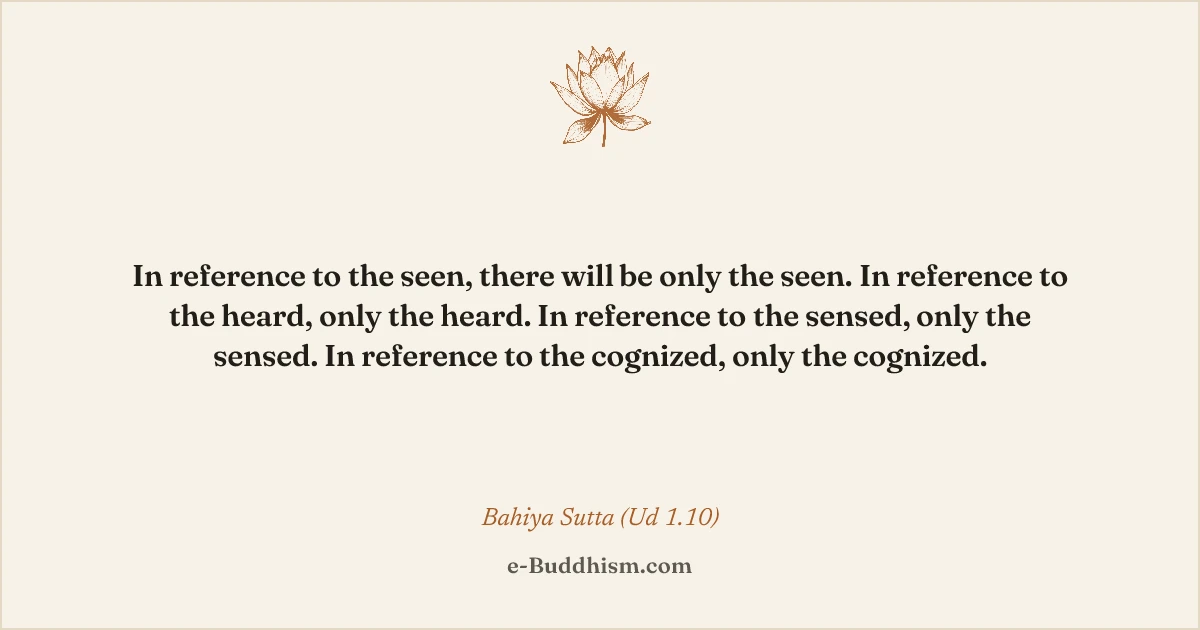
“In reference to the seen, there will be only the seen. In reference to the heard, only the heard. In reference to the sensed, only the sensed. In reference to the cognized, only the cognized.” — The Buddha, Bāhiya Sutta (Ud 1.10), trans. Thanissaro Bhikkhu
What it means
The teaching points to a gap we almost never notice. There is the bare event — a sight, a sound, a sensation, a thought — and then there is everything the mind instantly adds to it: I am seeing this, this is happening to me, I like it, I can’t stand it, what does it mean about my life. The Buddha’s instruction is to stop at the bare event. “In the seen, only the seen” — just the seeing, before the self-story.
What follows in the sutta is the punchline: when you can rest there, “there is no you in connection with that… This, just this, is the end of stress.” Much of our suffering is not in raw experience but in the self we construct around it. Take away that added layer of “I” and “mine,” and the suffering built on it has nothing to stand on.
This is not a trick for blanking out the senses. The world is still seen and heard, vividly. What drops away is the compulsive commentary that turns a passing sight into a problem about me. It is the essence of mindfulness taken to its sharpest point, and the doorway to the insight of not-self.
Where it comes from
The instruction is from the Bāhiya Sutta (Ud 1.10), in the Udāna (“Inspired Utterances”) of the Pali Canon; the translation is Thanissaro Bhikkhu’s. Bāhiya, a wandering ascetic convinced he was already awakened, sought out the Buddha and, sensing his time was short, refused to wait for a fuller teaching. The Buddha gave him this — and Bāhiya, the text says, awakened on the spot, dying soon after. The story is a standing reminder that realisation turns on clarity, not on length of years.
How to use it
In a quiet moment, let a single sense be bare. A sound arises — just hear it, without the label, the like, the dislike, the story. When the mind adds “I don’t like that noise,” notice that the adding is the extra step. Returning, again and again, to “only the heard” is the whole practice in miniature. For the fuller method, see insight (vipassanā) meditation.
Browse more sourced lines in our Buddhist quotes collection.
Frequently asked questions
What is the Bāhiya teaching?
It is one of the shortest and most pointed awakening instructions in the Pali Canon. The Buddha tells Bāhiya to let bare experience be just that: 'In reference to the seen, there will be only the seen… in the cognized, only the cognized.' Stop adding the extra layer of 'I' and 'mine' on top of what is simply seen, heard, sensed, or known — and, he says, 'there is no you in connection with that. This, just this, is the end of stress.'
What does 'only the seen' mean in practice?
It means meeting a sight as just a sight, before the mind builds it into a story about me — my liking, my fear, my judgment. The seeing happens; the trouble starts when we wrap a self around it ('I shouldn't have to see this'). The instruction is to rest in the bare event of experience itself, which is naturally free of that self-made suffering.
Who was Bāhiya?
Bāhiya was a wandering ascetic who, sensing he had little time, begged the Buddha for a teaching on the spot. The Buddha gave him this terse instruction; Bāhiya awakened almost immediately — and, the text says, died shortly after. The story is often told to show that the deepest realisation does not depend on long years, but on seeing clearly, now.
Sources
- Bāhiya Sutta (Ud 1.10), Access to Insight (trans. Thanissaro Bhikkhu) — https://www.accesstoinsight.org/tipitaka/kn/ud/ud.1.10.than.html