“Even as a Mother Protects Her Only Child” (Mettā Sutta)
The most famous image of love in all of Buddhism comes from the Mettā Sutta. The Buddha takes the fiercest, most selfless love most people will ever know — a mother ready to give her life for her only child — and asks us to feel it not for one being but for all of them, “with a boundless heart.” Here is the verse, its meaning, and its source.
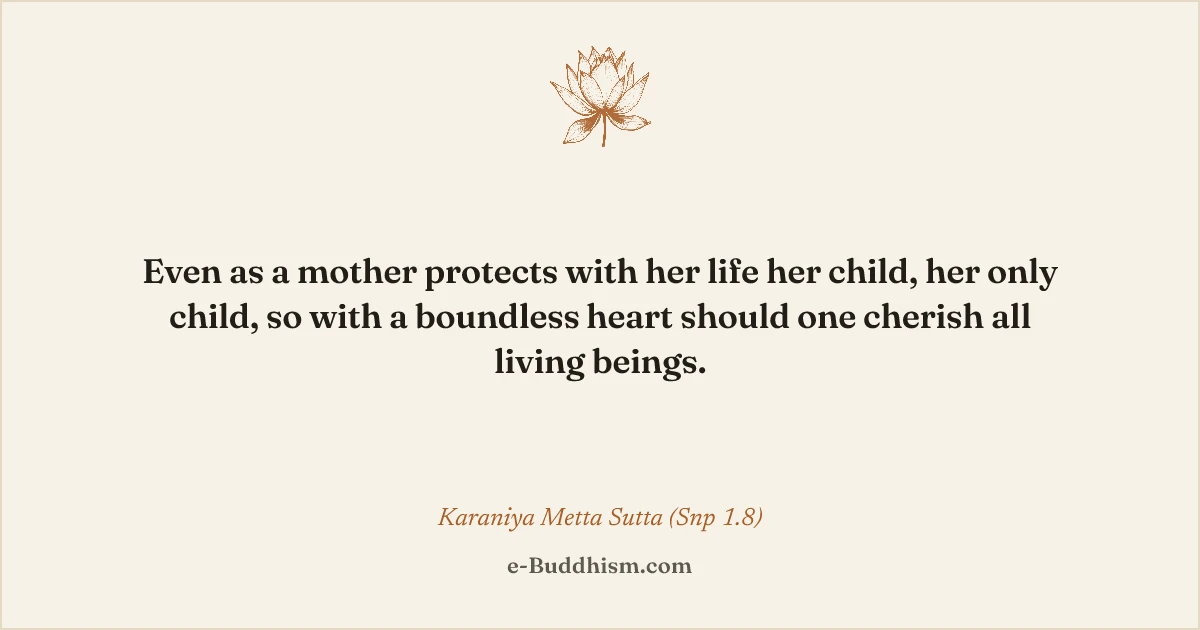
“Even as a mother protects with her life her child, her only child, so with a boundless heart should one cherish all living beings.” — The Buddha, Karaṇīya Mettā Sutta (Snp 1.8), trans. The Amaravati Sangha
What it means
Notice exactly what is — and is not — being asked. The Buddha is not saying “love everyone the way you love your own child,” as if we could simply manufacture that feeling on command. He is pointing to the quality of a mother’s love for her only child — its readiness to protect “with her life,” its complete absence of calculation — and asking us to take that quality and remove its boundary.
Ordinary love is real but fenced: this child, my family, my people. Mettā — loving-kindness — is what you get when you keep the warmth but take down the fence, until it reaches “all living beings” without exception, including the stranger and even the difficult person. The image is chosen precisely because a mother’s love is the least selfish love we know; it is the natural seed from which boundless goodwill can be grown.
The next lines of the sutta complete the picture, asking the practitioner to radiate this kindness “above, below, and all around, unobstructed, without hatred or ill-will.”
Where it comes from
The verse is from the Karaṇīya Mettā Sutta, the “Discourse on Loving-Kindness” (Snp 1.8), in the Sutta Nipāta of the Pali Canon — one of the most cherished and most frequently chanted texts in the Buddhist world. Tradition holds the Buddha taught it to a group of monks troubled by fear, as both protection and practice. The translation here is the Amaravati Sangha’s.
How to practise it
This verse is not only to be admired but done. It is the textual heart of loving-kindness (mettā) meditation, in which you deliberately extend goodwill outward in widening circles:
- Begin where warmth comes easily — a loved one, or yourself.
- Let the same wish — may you be happy, may you be safe — extend to a neutral person, then to someone difficult.
- Finally, as the sutta says, to all beings, “with a boundless heart.”
The mother’s love is the spark; the practice is what makes it boundless.
Browse more sourced lines in our Buddhist quotes collection.
Frequently asked questions
What does the Mettā Sutta say about a mother?
It offers the most famous image of loving-kindness in all of Buddhism: 'Even as a mother protects with her life her child, her only child, so with a boundless heart should one cherish all living beings.' The point is not that we should feel a mother's love only for our own — but that we should extend that same fierce, protective, all-giving care outward, without limit, to every living being.
Where is the quote from?
The Karaṇīya Mettā Sutta ('The Discourse on Loving-Kindness'), Snp 1.8, in the Sutta Nipāta of the Pali Canon. It is among the best-loved and most-chanted texts in Buddhism, recited daily in monasteries across the Theravāda world. The translation here is the Amaravati Sangha's.
Is a mother's love really the model for Buddhist compassion?
It is the model for its intensity and selflessness, not its narrowness. The sutta deliberately takes the strongest natural love most people know — a mother's willingness to die for her only child — and asks us to widen it until it has no boundary at all, excluding no one. That widening is exactly what mettā meditation trains.
Sources
- Karaṇīya Mettā Sutta (Snp 1.8), Access to Insight (trans. The Amaravati Sangha) — https://www.accesstoinsight.org/tipitaka/kn/snp/snp.1.08.amar.html