Mala Beads: What They Are and How to Use Them

Mala beads are a loop of beads used to count repetitions of a mantra, a Buddha’s name, or breaths during meditation. The name comes from the Sanskrit japamala — “recitation garland”. A classic Buddhist mala has 108 counting beads plus one larger “guru” bead, and you move one bead at a time with your thumb, reciting once per bead. This guide explains what they are, what the parts mean, and exactly how to use them.
What Are Mala Beads?
A mala (japamala) is a simple counting tool. When you are repeating something many times — a mantra, the name of a Buddha, or even just the breath — it is hard to keep an accurate tally in your head without the counting itself pulling your attention away from the practice. The mala solves this quietly: each bead is one repetition, so your fingers keep the count while your mind stays on the words. The Sanskrit mālā means “garland”, and japa means “muttered recitation”, so the whole word means something close to “garland for recitation”.
You will also hear malas called Buddhist prayer beads, though “prayer” is a loose translation — much of what is counted on them is mantra or recollection rather than petitionary prayer in the Western sense (our guide to Buddhist mantras explains how mantra works). The practice is genuinely shared: Buddhists, Hindus, and others use beads of this kind, and the Buddhist mala has close cousins in the Hindu japa mala and the Japanese juzu/nenju.
For where this sits in a wider practice, see our Buddhism for beginners guide.
The Parts of a Mala
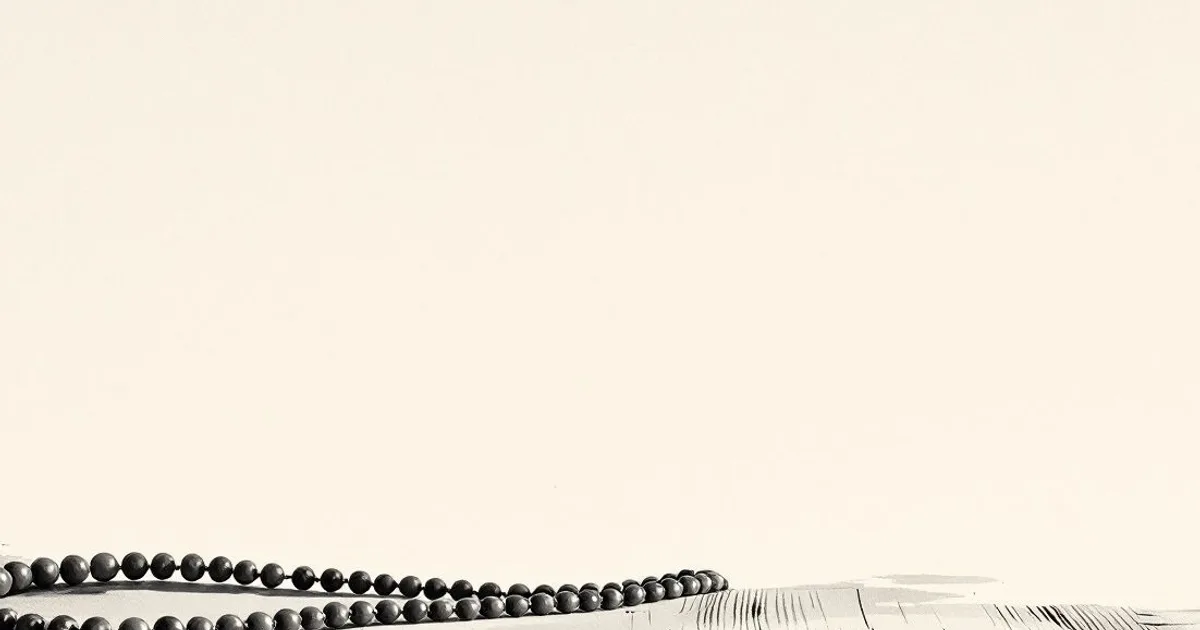
The 108 counting beads
The standard Buddhist mala has 108 beads that you actually count. Shorter malas exist too — commonly 54, 27, or 18 beads, all of which are factors of 108, and other sizes such as 21 — and these are used for shorter rounds or worn on the wrist. So if you have a small wrist mala, it is not a “lesser” mala; it is simply sized for a shorter cycle.
The guru bead
Set apart from the 108 is a single larger bead, usually with a tassel or a small three-holed “head” piece above it. This is the guru bead (also called the meru, Sumeru, bindu, or “mother” bead). It is not counted. Its job is to mark where a round begins and ends, and — as we will see — to tell you when to turn around.
What the 108 means (honestly)
It is worth being straight about this, because the internet is full of confident, contradictory explanations. The number 108 is traditionally regarded as auspicious or sacred across Indian religions, and a great many symbolic meanings have been attached to it — counts of sacred texts, of defilements or “afflictions” to be overcome, of energy channels, even astronomical ratios. These are part of a rich folk and devotional tradition, but they are not a single fixed doctrine, and different schools and teachers explain 108 differently or not at all.
The practical truth is simpler: 108 is a generous, consistent round to count, hallowed by long use. You can hold the symbolism lightly without losing anything that matters about the practice.
How to Use Mala Beads (Step by Step)
Here is the core method as taught in the Tibetan tradition, which is the most widely described. Where customs differ, we say so afterwards.
- Hold the mala. Drape it over the fingers of one hand. The most common custom is to hold it in the left hand, letting the beads rest over the index finger, with the thumb free to move them — but this varies (more below).
- Find your starting bead. Begin at the first bead next to the guru bead. That guru bead is your landmark; you start just after it.
- Recite once per bead. Say your mantra — for example, the well-known om mani padme hum — once while holding that first bead. You can recite aloud or silently.
- Advance one bead. Use your thumb to draw the next bead toward you, and recite again. One bead, one recitation. Let the rhythm settle; the point is steady attention, not speed.
- Continue around the loop. Keep going, bead by bead, until you have come all the way around and arrive back at the guru bead — that is 108 recitations, one full round.
- Do not cross the guru bead. When you reach it, do not count it and do not pass over it. Pause for a moment — many people use this as a beat of gratitude or dedication.
- Reverse direction for the next round. If you want to continue, simply flip the mala and go back the way you came, so the last bead of the previous round becomes the first bead of the next. You never step over the guru bead; you always turn around at it.
That is the whole technique. It is forgiving, and your intention and steadiness matter far more than perfect form.
Why you turn around at the guru bead
Reversing rather than crossing is a respected convention. In Tibetan Buddhism it is explained as a mark of respect toward one’s spiritual teacher (the “guru” the bead is named for) — you do not “tread over” the teacher. Treat it as a meaningful custom rather than an iron rule: doing it preserves a lovely piece of etiquette, but no harm comes if you are still learning.
Which Hand, Which Finger? (Customs Vary)
This is where honest guidance matters, because confident sources disagree. The general custom — and the one most Tibetan teachers describe — is to hold the mala in the left hand and move the beads with the thumb over the index finger. But some practitioners and traditions use the right hand, and some teachers specifically avoid the index finger, moving beads against the middle finger instead, because the index finger is associated with pointing and blame.
The most reliable teachers tend to add the same reassurance: there are no strict, universal rules, everyone does it slightly differently, and what counts is your concentration and your attitude — not flawless hand position. So learn your own tradition’s custom if you have one, and otherwise pick the way that lets you keep your attention and stick with it.
What People Count on a Mala
A mala is just a counter — what you recite on it depends on your tradition and aim. Common choices include:
- A mantra, such as om mani padme hum. See our guide to Buddhist mantras for what mantras are and how repetition works.
- A Buddha’s name, most famously the recitation of Amitābha’s name in Pure Land practice (often “Namo Amituofo” / “Namu Amida Butsu”).
- A phrase of cultivation, for instance the phrases of loving-kindness (metta) meditation, using each bead to extend goodwill.
- The breath — one bead per breath — as a simple anchor for attention.
The mala does not make any of these “work” by itself; it keeps the count so your mind can rest in the practice.
How the Traditions Differ
Mala use is genuinely shared across traditions, but it is not identical everywhere — and it would be misleading to present one form as “the” Buddhist way.
- Tibetan Buddhism (Vajrayāna) makes the most elaborate use of malas: 108-bead rounds, often with small counter strings of beads to tally thousands or even hundreds of thousands of recitations during longer practices.
- Japanese Buddhism uses beads called juzu or nenju, and the form differs noticeably from sect to sect — Shingon, Tendai, Nichiren, and Zen schools each have their own bead arrangements and tassels, so much so that a practitioner’s beads can signal which school they belong to.
- Pure Land (Jōdo Shinshū) is an instructive case: the o-nenju are not primarily used for counting at all. In this tradition recitation of the Buddha’s name is not about hitting a number; the beads are held over both hands in gasshō (palms together) as an expression of respect and an aid to a reverent attitude.
- Theravāda practice traditionally leans more on breath and insight meditation than on bead-counting, though prayer beads are used in some Theravāda cultures, especially for recollection practices.
- Hinduism shares the practice as japa, with its own conventions — for example, rudraksha beads favoured by devotees of Shiva and tulasi wood by Vaiṣṇavas.
If you have a teacher or tradition, follow its conventions. If you do not, the simple Tibetan-style method above is a perfectly respectful place to begin.
What Malas Are Made Of
Malas are made from many materials, and the choice is partly practical, partly symbolic. Traditional ones include:
- Bodhi seeds — from the kind of tree under which the Buddha is said to have awakened, a popular and meaningful choice.
- Sandalwood — fragrant and traditional.
- Rudraksha — the dried fruitstones of the rudraksha tree, very common in Indian practice.
- Bone (often yak bone in Tibetan malas) — a reminder of impermanence and mortality.
- Gemstones and semiprecious stones — such as lapis lazuli, carnelian, or amethyst.
No material is required, and an inexpensive mala is in no way inferior for practice. Many practitioners come to value a mala simply because it is the one they have used, day after day.
Caring for a Mala
There are no rigid rules here either, but a little care reflects the spirit of the practice. Keep your mala somewhere clean and respectful rather than tossed in with loose change; many people store it on their home altar when not in use. If you wear it, that is fine in most traditions — though, again, customs vary, and some people prefer to reserve it for practice. Handle it as you would any object you genuinely respect, and you will not go far wrong.
A Simple Way to Start
If you would like to begin today: take any mala, hold it in your left hand, and start at the bead beside the guru bead. Choose one short mantra or phrase — om mani padme hum is a fine and gentle choice — and recite it once per bead, drawing each bead toward you with your thumb. When you reach the guru bead, pause, give thanks, and either stop or turn around for another round. Do that for a few minutes a day and you have a real, unfussy practice.
For the bigger picture of where this fits, return to Buddhism for beginners; to understand what you are actually reciting, see Buddhist mantras; and for unfamiliar terms, our glossary explains the key words as they come up.
Frequently asked questions
What are mala beads?
Mala beads are a loop of beads used to count repetitions of a mantra, a Buddha's name, or breaths during meditation. The word comes from the Sanskrit japamala, meaning 'recitation garland'. A classic Buddhist mala has 108 counting beads plus one larger 'guru' bead, and you advance one bead per recitation with your thumb. They are used across Buddhist traditions and, in related forms, in Hinduism.
Why do malas have 108 beads?
The number 108 is traditionally regarded as auspicious or sacred across Indian religions, and many symbolic explanations are offered for it — but it is a venerable tradition, not a fixed doctrine, and the explanations vary. The practical point is that 108 gives a generous, consistent round to count. Shorter malas of 54, 27, or 18 beads (all factors of 108) are also common for briefer rounds or for wearing on the wrist.
How do you use mala beads, step by step?
Hold the mala in one hand (the left hand is the usual custom). Start at the first bead next to the large guru bead. Recite your mantra once, then use your thumb to draw the next bead toward you and recite again — one recitation per bead. When you come back round to the guru bead, do not count or cross it: pause, then reverse direction and continue back the way you came for another round.
Why do you not cross the guru bead?
The larger 'guru' bead (also called the meru, Sumeru, or mother bead) marks the start and end of a round and is not counted. By convention you do not pass over it; instead you stop, often with a moment of gratitude, and reverse direction. In Tibetan Buddhism this is explained as a mark of respect toward one's spiritual teacher. It is a respected custom rather than a strict rule, and you will not 'ruin' anything if you do it differently.
Do you have to be Buddhist to use mala beads?
No. Malas are a tool for steadying attention while you repeat a word, phrase, or breath, and many people use them simply as an aid to meditation or as a calming habit. That said, they carry real meaning in Buddhist and Hindu practice, so it is respectful to learn what they are and to handle them with care rather than treating them purely as jewellery.
Sources
- 'Japamala' (Sanskrit japa, 'recitation' + mālā, 'garland'), Wikipedia — structure of 108 beads plus an uncounted 'guru' bead (also meru/Sumeru/mother bead); smaller malas of 54, 27, 18 beads as factors of 108 (and other sizes such as 21); materials (bodhi seed, sandalwood, rudraksha, bone, gemstone); use across Tibetan Buddhism, Japanese juzu/nenju, and Hindu japa
- 'How to Use Tibetan Mala Prayer Beads', Tibetan Nuns Project (tnp.org) — mala held in the left hand, thumb advancing each bead over the index finger; one round = 108 recitations; at the guru bead you do NOT cross it but reverse direction, 'as a sign of respect towards one's spiritual teachers'
- 'O-nenju: Understanding Buddhist Beads', Higashi Honganji USA (higashihonganjiusa.org) — in Jōdo Shinshū / Pure Land, the o-nenju are not primarily for counting; held over both hands in gasshō as an expression of respect