Mantra Meditation and the Power of Sacred Sound

Mantra meditation in Buddhism is the focused repetition of a sacred sound, syllable, or phrase to concentrate the mind and — especially in Vajrayāna — to invoke and embody enlightened qualities. The word mantra is often glossed as “mind-protection.” Its aim is one-pointed focus and devotion, not magic.
The short answer
A mantra (Sanskrit) is a sound, word, or phrase recited repeatedly as an aid to meditation. Encyclopædia Britannica describes a mantra as a “sacred utterance” believed to possess spiritual power, used as an object of concentration. The Sanskrit word is usually parsed as man- (“to think,” and so “mind”) plus the instrumental suffix -tra (“tool”) — literally a “mind-tool.” A second, older reading, prominent in Mahāyāna and especially Tibetan Buddhism, hears -tra as trā- (“to protect, rescue”), giving the famous gloss of mantra as “that which protects the mind.” Both senses point the same way: a mantra is something the mind holds onto so as to stay gathered and guarded against distraction.
To practise mantra meditation, then, is to make that repetition the heart of one’s meditation — resting attention on the sound, returning to it whenever the mind strays. It is one method among many, not the whole of Buddhist practice, and its character changes depending on the tradition. (For the great mantras themselves and what each one means, see our companion guide to Buddhist mantras; unfamiliar terms are in the glossary.)
In more depth
What a mantra does
At its simplest, a mantra gives the mind a single, repeatable object. Where mindfulness of breathing rests attention on the breath, mantra practice rests it on a sound. The repetition crowds out the inner chatter of memory, plan, and worry, and gathers a scattered mind into one place. In this respect mantra recitation is a form of concentration practice — a doorway to the calm and collectedness the tradition calls samādhi.
But in much of Buddhism a mantra is more than a concentration aid. Especially in Vajrayāna (the Tibetan tantric tradition), a mantra is understood as the sound-body of an awakened being — a way of invoking and gradually embodying the enlightened qualities that being represents. Reciting a bodhisattva’s mantra is, in this view, a means of attuning one’s own body, speech, and mind to theirs. This is why the practice is at once concentrative and devotional: the point is not to acquire magical power but to steady the mind and open the heart.
How to practise mantra meditation
The method is simple to describe and rewards patient repetition:
- Choose a mantra and learn it well. Pick one mantra and learn its correct pronunciation from a reliable source or teacher — sound matters in this practice, and a garbled mantra is hard to settle on. For most people om mani padme hum (below) is a natural, non-sectarian place to begin.
- Sit with an upright, relaxed posture. A straight but unforced spine, shoulders soft, hands resting easily. You can close the eyes or keep them lowered.
- Settle with a few breaths. Before starting, take a handful of natural breaths to arrive and let the body quieten.
- Begin the repetition. Recite the mantra steadily — aloud, in a low whisper, or silently in the mind. Aloud is grounding for beginners; silent recitation suits deeper concentration. Let the pace be even and unhurried.
- Rest attention on the sound. Listen to the mantra as you make it. Let the syllables fill your attention; you do not need to force meaning or visualise anything to benefit.
- Return when you wander. The mind will drift. Each time you notice it has, gently bring it back to the mantra. That returning is the practice — not a failure of it.
- Use a mālā to count, if you wish. A mālā (string of prayer beads) lets you count repetitions by touch, so the mind can stay on the sound rather than on numbers (see below).
- Begin small and be regular. A few minutes daily, kept gently, will do more than an occasional marathon. Close by sitting quietly for a moment before you rise.
A short note on attitude: the tone of mantra practice is steady devotion, not strain. You are not trying to achieve a state by willpower but to keep returning, lightly, to a sound you trust.
Counting with a mālā
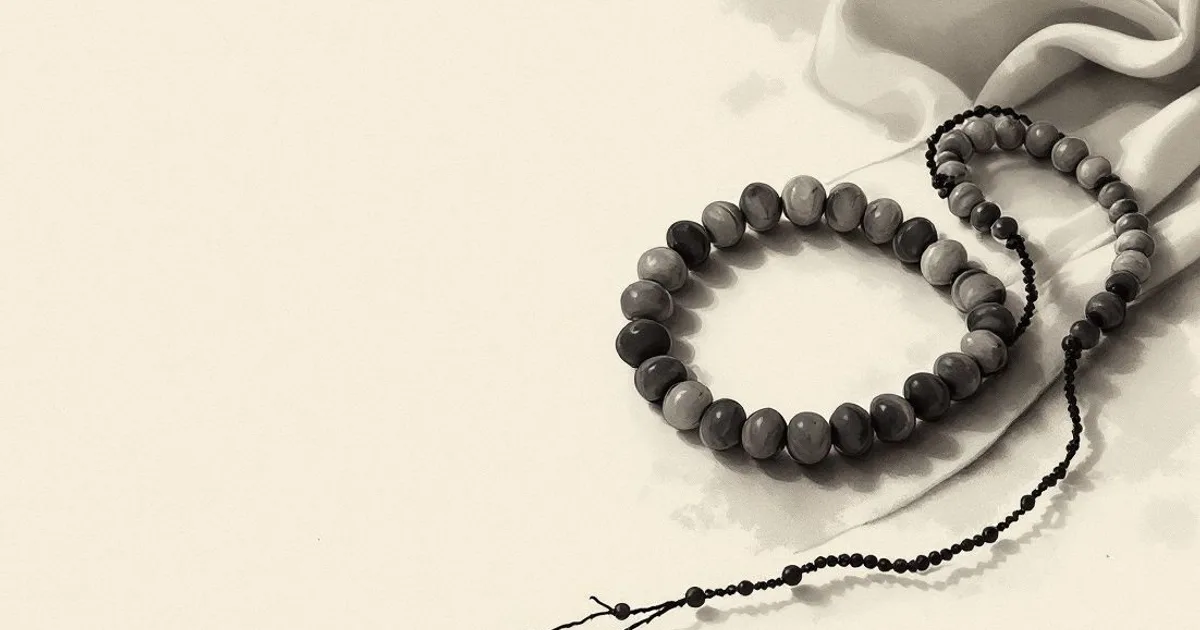
Many traditions count recitations on a mālā (Sanskrit mālā, “garland”) — a loop of prayer beads. The classic mālā has 108 beads, a number of long significance across Indian religions, plus a distinct larger “guru” or “mother” bead that marks the start and is not counted. The practitioner moves the thumb over one bead per recitation; completing the loop is one round (108), and reaching the guru bead is the cue to pause or, traditionally, to turn the mālā around rather than cross it. Smaller malas of 54 or 27 beads — factors of 108 — are also common. The purpose is humble and practical: the beads keep count so the mind doesn’t have to, freeing attention to rest on the sound. (The repetitive recitation of a mantra in this way is sometimes called japa, “muttering” or quiet repetition.)
The great Buddhist mantras
A handful of mantras are recited by millions; our Buddhist mantras page treats them in full, but here is the orientation.
Om mani padme hum is the most widespread mantra in Tibetan Buddhism, associated with Avalokiteśvara — Chenrezig in Tibetan — the bodhisattva of compassion. It first appears in the Mahāyāna Kāraṇḍavyūha Sūtra, where it is called the “innermost heart” of Avalokiteśvara. Maṇi means “jewel” and padme “lotus,” and the phrase is often rendered loosely as “the jewel in the lotus.” Traditional commentary, including a well-known explanation by the present Dalai Lama, reads its six syllables as the entire path of method and wisdom by which the practitioner’s ordinary body, speech, and mind are transformed into those of a buddha. It is recited aloud and silently, carved on stones, and rolled in prayer wheels across the Himalaya.
Gate gate pāragate pārasaṃgate bodhi svāhā is the mantra that closes the Heart Sūtra, the most beloved of the Prajñāpāramitā (“perfection of wisdom”) texts. It is commonly translated “Gone, gone, gone beyond, gone completely beyond — awakening, so be it” (the Sanskritist Edward Conze rendered it “Gone, gone, gone beyond, gone altogether beyond, O what an awakening, all-hail!”). Where many mantras are seed-syllables, this one is a near-translatable evocation of the journey to the far shore of liberation.
Pure Land recitation: recollection, not a classical mantra
A careful word is owed here, because the distinction is easy to blur. In Pure Land Buddhism, the central practice is the repeated recitation of the name of Amitābha Buddha — Chinese nianfo (念佛), Japanese nembutsu — in forms such as “Namo Amituofo” or “Namu Amida Butsu.” These phrases mean roughly “Homage to Amitābha Buddha,” and the practice expresses trust in Amitābha’s vow to bring the practitioner to rebirth in his Pure Land.
This is not, strictly speaking, a classical mantra. The term nianfo literally translates the Sanskrit buddhānusmṛti — buddha-recollection (buddhānussati in Pāli), one of the ancient mindfulness practices: the calling-to-mind of a buddha’s qualities. What is recited is a name and homage, an act of recollection of and entrusting to a buddha, rather than a seed-syllable mantra of the Vajrayāna kind. In ordinary speech, and even in some practice settings, people group the nembutsu with mantra recitation because they look alike — a sacred phrase, repeated, often on beads. But the traditions themselves draw the line, and it is worth keeping accurate: Pure Land recitation is buddha-recollection; a Vajrayāna mantra is something else.
The daimoku of Nichiren
A third great chanting practice should be named for completeness. In Nichiren Buddhism the central recitation is the daimoku — “Nam-myoho-renge-kyo,” meaning roughly “Devotion to the Mystic Law of the Lotus Sūtra.” Publicly taught by the Japanese teacher Nichiren in 1253, it is the invocation of the title (daimoku) of the Lotus Sūtra, held in this tradition to contain the sūtra’s whole power. Like the nembutsu, it is a phrase of faith and devotion rather than a classical seed-syllable mantra — another reminder that “chanting practice” in Buddhism is not one thing but several, each with its own logic.
When you need a teacher
Much mantra practice can be taken up freely. Reciting om mani padme hum devotionally, or quietly using a mantra to steady the mind, needs no special permission. But in Vajrayāna many mantras belong to specific deity practices — and these are traditionally transmitted only through a formal empowerment (initiation) and the guidance of a qualified teacher. Deity yoga in particular is not a do-it-yourself technique: the tradition is emphatic that such practices are received, not invented. (On deity yoga itself — how the visualization is built and dissolved — see visualization meditation.) If a practice you encounter calls for empowerment, the honest course is to seek that transmission rather than improvise it.
Keeping the aim straight
For all the beauty of these sounds, their purpose is plain: a gathered, devoted mind. A mantra is not a spell that bends the world, and the traditions that hold it most sacred are also the clearest that magical thinking misses the point. Recited well — patiently, attentively, with the heart turned toward what the sound represents — a mantra steadies the practitioner and inclines them toward compassion and wisdom. That is the power of sacred sound in Buddhism: not that the syllables work on the world, but that, repeated faithfully, they work on us. To go further, explore the great mantras in detail, count your rounds on our digital mala, or return to the wider map of Buddhist meditation.
Frequently asked questions
What is mantra meditation in Buddhism?
Mantra meditation is the focused repetition of a sacred sound, syllable, or phrase to steady the mind and, especially in Vajrayāna Buddhism, to invoke and embody enlightened qualities. The word 'mantra' is often glossed in the Tibetan tradition as 'mind-protection.' The point is one-pointed concentration and devotion — not magic — and it is one method within the wider field of Buddhist meditation, not the whole of it.
How do you practise mantra meditation step by step?
Choose a mantra and learn its correct pronunciation; sit comfortably with a straight, relaxed spine; settle with a few natural breaths; then repeat the mantra steadily — aloud, whispered, or silently — letting attention rest on the sound. When the mind wanders, notice it and gently return to the mantra. Many practitioners use a mālā (string of 108 beads) to count repetitions so the mind can stay on the sound rather than on counting. Begin with a few minutes and let the practice grow.
What does Om mani padme hum mean?
Om mani padme hum is the most widely recited mantra in Tibetan Buddhism, associated with Avalokiteśvara (Tibetan: Chenrezig), the bodhisattva of compassion. It first appears in the Mahāyāna Kāraṇḍavyūha Sūtra. 'Maṇi' means 'jewel' and 'padme' means 'lotus'; it is often rendered loosely as 'the jewel in the lotus.' Traditional commentary reads the six syllables as the whole path of method and wisdom that transforms ordinary body, speech, and mind into those of a buddha.
Is the Pure Land nembutsu a mantra?
Not in the classical sense. The Pure Land recitation of Amitābha Buddha's name — Chinese nianfo, Japanese nembutsu, 'Namo Amituofo' / 'Namu Amida Butsu' — is buddha-recollection (Sanskrit buddhānusmṛti); 'nianfo' literally translates that term. It is an act of mindful recollection of and entrusting to a buddha, rather than a classical seed-syllable mantra of the kind found in Vajrayāna. Many people group them together loosely, but the traditions themselves draw the distinction.
Do I need a teacher for mantra meditation?
For simple, well-known mantras recited devotionally, you can begin on your own. But in Vajrayāna (Tibetan) Buddhism, many mantras belong to specific practices — especially deity yoga — that are traditionally transmitted only through formal initiation (empowerment) and the guidance of a qualified teacher. If a practice calls for empowerment, seek that transmission rather than improvising it.
Sources
- Mantra (entry), Encyclopædia Britannica
- Mantra (entry), Wikipedia
- Oṃ maṇi padme hūṃ / Kāraṇḍavyūha Sūtra (entry), Wikipedia
- Heart Sutra (Prajñāpāramitāhṛdaya) (entry), Wikipedia
- Nianfo (entry), Wikipedia
- Namu Myōhō Renge Kyō (entry), Wikipedia
- Japamala (entry), Wikipedia