Mount Meru: The Center of the Buddhist Universe
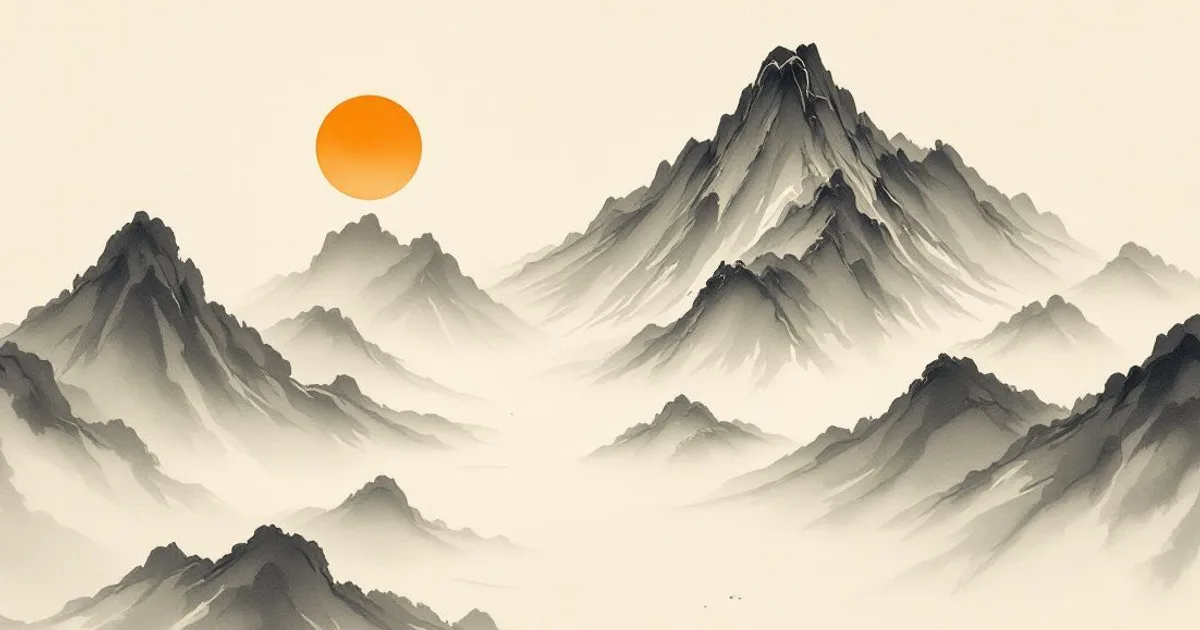
Mount Meru (also Sumeru) is the colossal mountain at the very center of the Buddhist universe — the axis around which the whole cosmos is arranged. Towering at the heart of the world-system, ringed by oceans and continents and crowned by a heaven of gods, it gives the Buddhist cosmos its shape. It is one of the grandest images in all of Buddhist thought.
The axis of the world
In the classical picture, Meru rises at the exact center of the world, and everything else is laid out in symmetry around it. As Encyclopædia Britannica describes the scheme, the mountain is “topped by the heaven of the 33 gods,” over which Indra — called Sakka in the Pāli texts — presides. This summit-heaven, Tāvatiṃsa, is one of the six sense-sphere heavens in the map of the 31 planes; the figure of Meru literally holds up the lower cosmos.
Mount Meru is not unique to Buddhism. It is a shared inheritance of ancient Indian cosmology, appearing also in Hinduism and Jainism — one of the deep structures the Buddha’s tradition took up from its Indian world and put to its own use.
The shape of the great mountain
The classical sources describe Meru with startling precision. The Abhidharmakośa, the great Buddhist compendium of cosmology, gives it staggering dimensions — some 80,000 yojanas high and as many wide (a yojana being a measure of several miles), a mountain on a scale no earthly peak approaches. Its four sides are each made of a different precious substance — gold, crystal, lapis lazuli, and ruby — and the blue of the southern, lapis face is said to tint the very sky we see.
Around its waist, halfway up the slopes, lies the heaven of the Four Great Kings, guardians of the four directions; at its summit sits the Heaven of the Thirty-Three, where Sakka presides. Ringing the mountain are seven concentric ranges of golden mountains, each parted from the next by a circular sea. And around Meru, the tradition holds, the sun and moon revolve — so that night falls on our continent when the sun passes behind the great mountain’s bulk. It is less a map than a vision: the whole cosmos as a single ordered, jewelled architecture, turning around one centre.
Oceans, continents, and the iron ring
Around the great mountain, Britannica continues, lies “a great ocean” in which sit four island-continents, each inhabited by a different kind of being. The southern continent — our own — is Jambudvīpa, “loosely correlated with South, and sometimes Southeast, Asia.” It is here, in Jambudvīpa, that human beings live and that buddhas appear.
The whole world-system is not open-ended but enclosed: a vast circular wall of iron mountains, the cakkavāḷa, rings the entire ocean like the rim of a wheel, containing the realm of desire within it. The material world inside is built, the texts say, from the four elements — earth, water, fire, and air — held together in their countless combinations. The result is a cosmos of extraordinary order and symmetry: a single mountain, four continents, a ringing sea, a wall of iron, all turning around one center.
A cosmos in motion
This world-system is not eternal or static. Like everything in Buddhism, it is subject to impermanence — on a scale almost beyond imagining. Britannica describes time moving “in cycles of great duration,” in which the entire cosmos passes through a period of involution, when it is destroyed by fire, water, or air; then a period of reformation, when the structure builds again; then long ages of decline and renewal; before dissolving once more and beginning afresh. Mount Meru itself arises and passes away with each turning of these cosmic aeons. Even the axis of the world is impermanent.
How to read Mount Meru today
Modern readers naturally ask whether any of this is “real.” The classical texts present Meru as a literal, physical mountain of staggering dimensions, and for much of Buddhist history it was understood that way. Most Buddhists today read it instead as cosmological symbolism — a way of picturing the structure, the scale, and the hierarchy of existence, rather than a peak to be located on a map. (This is part of the wider question we take up in are the realms literal or psychological?)
Read either way, Mount Meru remains one of the most powerful images Buddhism offers: the whole of existence, from the hells to the heavens, gathered into a single ordered cosmos around one shining center — and the whole of it impermanent, turning, and ultimately to be transcended. Its form echoes through Buddhist art, from the shape of the stūpa to the center of every mandala. (For the full picture, see Buddhist cosmology; unfamiliar terms are in the glossary.)
Frequently asked questions
What is Mount Meru in Buddhism?
Mount Meru (also Sumeru) is the colossal mountain at the very center of the Buddhist world-system — the axis of the cosmos. According to Encyclopaedia Britannica, it is topped by the heaven of the 33 gods, over which Indra (Sakka) presides, and is surrounded by a great ocean holding four island-continents. It is a shared feature of ancient Indian cosmology, also found in Hinduism and Jainism.
Is Mount Meru a real mountain?
In the classical texts it is described as a literal, physical mountain of staggering size at the center of the world. Most Buddhists today understand it as cosmological symbolism rather than geography — a picture of the structure and scale of existence rather than a peak one could climb. Either way, its role is to organise the realms of the cosmos around a central axis.
What is Jambudvipa?
Jambudvipa is the southern of the four island-continents that surround Mount Meru in the great ocean — and it is the one human beings inhabit. Britannica notes it is loosely correlated with South, and sometimes Southeast, Asia. Its name means roughly 'the rose-apple continent,' and in Buddhist cosmology it is the world in which buddhas appear.
What is on top of Mount Meru?
Its summit holds Tavatimsa, the heaven of the Thirty-Three gods, ruled by Indra (called Sakka in the Pali texts). Below and around it are arrayed the other realms of the sensuous world. Above the mountain rise the still more refined heavens of the fine-material and immaterial realms — so Meru stands at the meeting point of the lower cosmos and the higher.
Sources
- Mount Meru (mythology) (entry) & Buddhism: Cosmology, Encyclopædia Britannica — the central cosmic mountain topped by the heaven of the 33 gods over which Indra (Sakka) presides; surrounded by a great ocean containing four island-continents, the southern one (loosely correlated with South/Southeast Asia) called Jambudvīpa; the whole enclosed by the cakkavāḷa, a ring of iron mountains; the material realm of desire composed of the four elements (earth, water, fire, air); time moving in vast cycles of involution and reformation
- Abhidharmakośa — Mount Meru's structure: ~80,000 yojanas high and wide; four faces of gold, crystal, lapis lazuli, and ruby; the Heaven of the Four Great Kings on its slopes and the Heaven of the Thirty-Three at its summit; seven rings of golden mountains and seas; the sun and moon revolving around it