“Overcome the Angry by Non-Anger”: Dhammapada 223
Where Dhammapada 5 states the principle — enmity cannot end enmity — Dhammapada 223 turns it into a practical recipe. The Buddha names four faults and, for each, the single quality that actually overcomes it: meet anger with non-anger, evil with good, greed with giving, and lies with truth. Here is the verse, what it means, and how to use it.
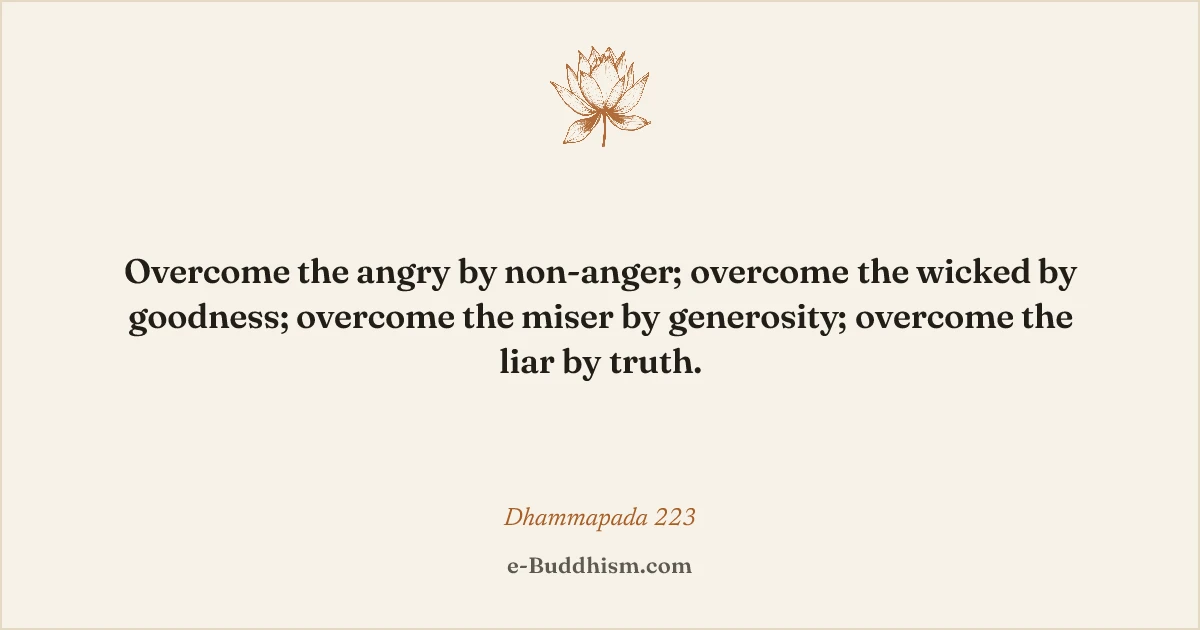
“Overcome the angry by non-anger; overcome the wicked by goodness; overcome the miser by generosity; overcome the liar by truth.” — The Buddha, Dhammapada 223 (trans. Acharya Buddharakkhita)
What it means
The verse works by opposites, and the choice of opposites is precise. Anger is not overcome by suppressing it or by out-shouting it, but by non-anger (Pali akkodha) — a steadiness close to active goodwill. Wickedness is met not with punishment but with goodness; miserliness not with shaming but with the contrary act of giving; lying not with counter-lies but with truth.
Two things make this more than a tidy slogan. First, it is active, not passive. “Non-anger” is something you do — a deliberate response cultivated in advance, not merely the absence of a reaction. Second, it insists that each fault has its own specific antidote: you cannot defeat stinginess with honesty or anger with generosity. The cure must be the direct opposite of the disease.
This is the same insight the Apostle Paul later put as “overcome evil with good,” and that runs through many traditions — but the Dhammapada states it with unusual completeness, mapping four faults to four remedies in a single line.
Where it comes from
The verse is Dhammapada 223, from the Kodhavagga — the “Chapter on Anger” — which gathers the Buddha’s teachings on ill-will and its cure. It belongs to the Pali Canon, and the wording here is Acharya Buddharakkhita’s.
How to practise it
- Pick the matching antidote. When you notice a fault arising — in yourself or in how you want to respond to someone — name it precisely, then apply its specific opposite. Anger → a deliberate act of non-anger or kindness. Stinginess → an actual gift.
- Prepare the response in advance. Non-anger is hard to summon mid-flare. It is built beforehand, especially through loving-kindness meditation, so it is available when you need it.
- Go deeper on the emotion. For the fuller teaching on working skilfully with this one, see Buddhism and anger.
Browse more sourced lines in our Buddhist quotes collection.
Frequently asked questions
What does Dhammapada 223 mean?
It gives four antidotes, each defeating a fault with its opposite: meet anger with non-anger, wickedness with goodness, stinginess with generosity, and falsehood with truth. Rather than fighting fire with fire, the Buddha teaches that each negative quality is genuinely overcome only by deliberately practising its positive counterpart.
Is it 'conquer anger with love'?
That popular phrasing captures the spirit, but Acharya Buddharakkhita's translation of the actual verse reads 'overcome the angry by non-anger.' Non-anger (akkodha) is close to active goodwill, so 'conquer anger with love' is a fair gloss — but the precise word is non-anger, and the verse extends the same logic to three further faults.
How is this different from 'hatred is never appeased by hatred' (Dhammapada 5)?
They teach the same principle from two angles. Dhammapada 5 states the law — enmity cannot end enmity. Dhammapada 223 turns it into practical instruction — here is exactly what to do instead, fault by fault. The two verses are natural companions.
Sources
- Dhammapada 223 (Kodhavagga), Access to Insight (trans. Acharya Buddharakkhita) — https://www.accesstoinsight.org/tipitaka/kn/dhp/dhp.17.budd.html