“A Tamed Mind Brings Happiness” (Dhammapada 35)
The Buddha is honest about something we usually hide: the mind is restless. It is swift, hard to hold, and grabs at whatever it fancies. He doesn’t shame us for this — he simply names it, and then points to the reward of working with it: “a tamed mind brings happiness.” Here is the verse, its meaning, and its source.
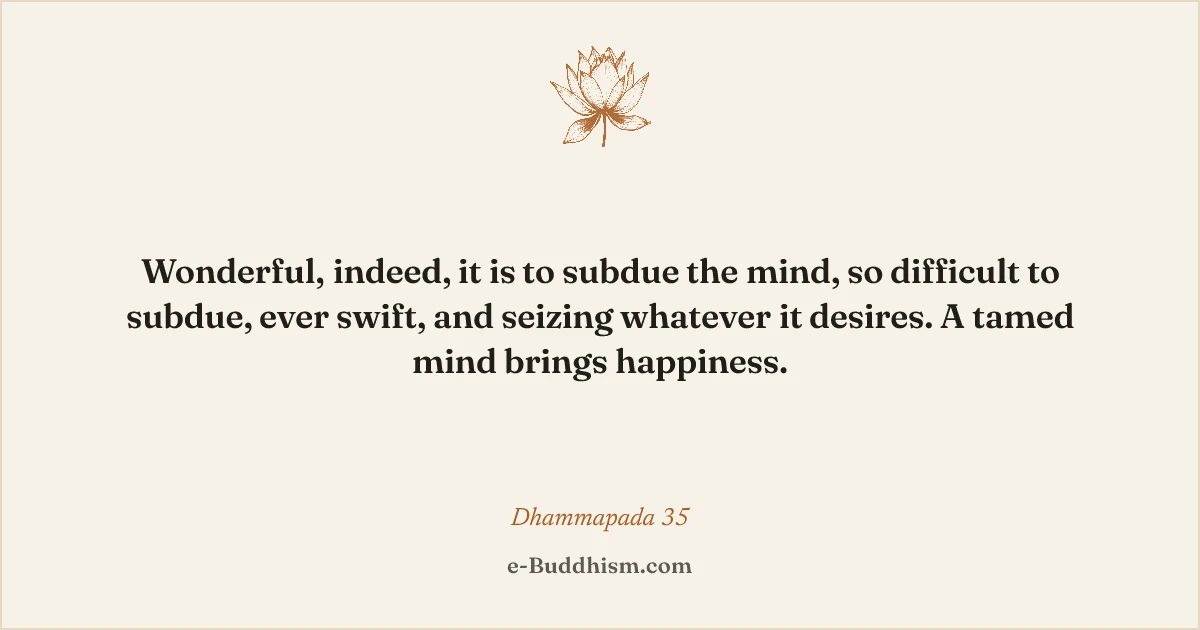
“Wonderful, indeed, it is to subdue the mind, so difficult to subdue, ever swift, and seizing whatever it desires. A tamed mind brings happiness.” — The Buddha, Dhammapada 35 (trans. Acharya Buddharakkhita)
What it means
Notice the verse begins with sympathy, not a command. The mind is “so difficult to subdue, ever swift, and seizing whatever it desires” — a fair description of almost anyone’s experience: thoughts darting, attention bolting, wants arising unbidden. The Buddha calls subduing such a mind “wonderful” precisely because it is hard. There is no pretence that it comes easily.
But the second half is the point: a tamed mind brings happiness. The word “tamed” matters. This is not about caging or crushing the mind, which only breeds tension. In Buddhist usage it is closer to gentling a spirited animal — steadying it, befriending it, so it stops dragging you behind it. A mind like that is workable; and a workable, settled mind is, the Buddha says, the very ground of contentment. Most of our unhappiness is not in events but in an untamed mind’s reaction to them.
Where it comes from
The verse is Dhammapada 35, from the Cittavagga — the chapter “on the Mind” — in the Pali Canon, in Acharya Buddharakkhita’s translation. The whole chapter circles this theme; verse 36 adds, “Let the discerning man guard the mind… a guarded mind brings happiness.”
How to practise it
The taming the verse praises is exactly what meditation trains. You do not subdue the mind by gripping it harder; you steady it by returning, again and again, with patience — which is also the skill that mindfulness describes. The classic obstacles you will meet along the way are mapped in our guide to the five hindrances.

Browse more sourced lines in our Buddhist quotes collection.
Frequently asked questions
What does Dhammapada 35 mean?
It names a fact most of us know but rarely admit: the mind is swift, hard to restrain, and grabs at whatever it wants. The Buddha doesn't scold us for this — he calls it 'difficult to subdue.' But he adds the payoff: a mind that is gently tamed, rather than left to bolt wherever it likes, is the source of genuine happiness.
How do you 'tame' the mind in Buddhism?
Not by force or suppression, but by training — chiefly meditation and mindfulness, which steady the mind enough to see its movements clearly and stop being dragged by every impulse. 'Taming' here is closer to befriending and steadying a restless animal than to caging it; the aim is a mind that is workable and at ease, not one that is crushed.
Where is it from?
Dhammapada 35, from the Cittavagga — the chapter 'on the Mind' — in Acharya Buddharakkhita's translation. The surrounding verses develop the same theme: the mind is hard to guard, but a guarded mind brings safety and happiness.
Sources
- Dhammapada 35 (Cittavagga), Access to Insight (trans. Acharya Buddharakkhita) — https://www.accesstoinsight.org/tipitaka/kn/dhp/dhp.03.budd.html