“The Faults of Others Are Easily Seen” (Dhammapada 252)
The Buddha catches us in a habit we rarely admit: we see other people’s faults at a glance — and broadcast them — while our own stay conveniently out of view. We “winnow” their failings like chaff in the wind, he says, but hide our own like a hunter behind camouflage. Here is the verse, its meaning, and its source.
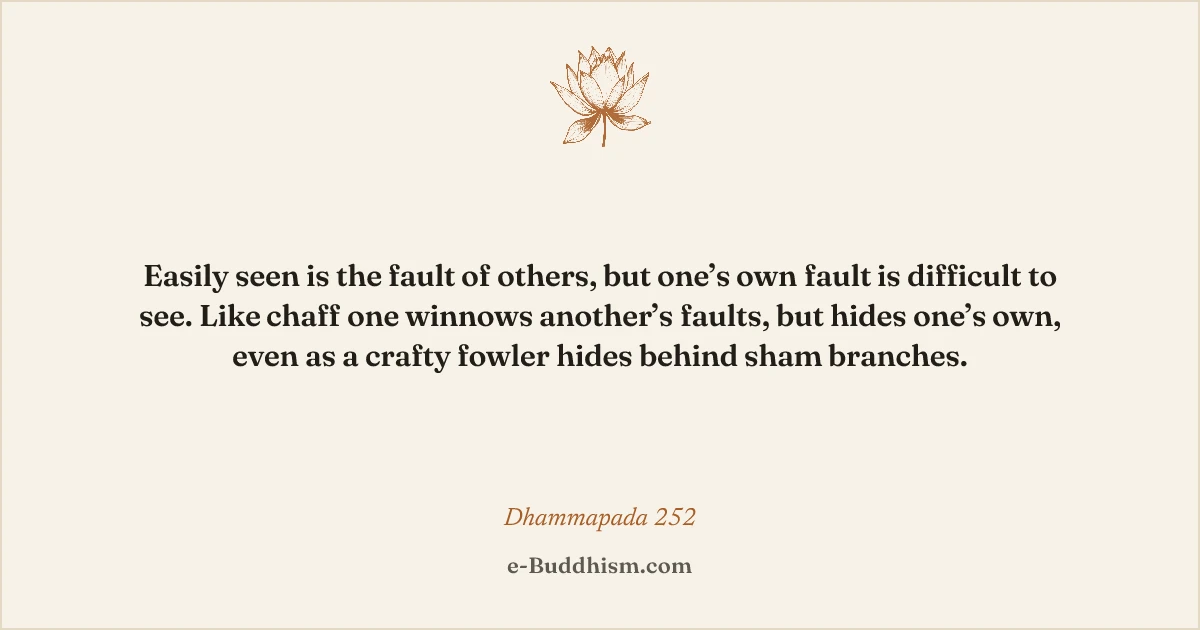
“Easily seen is the fault of others, but one’s own fault is difficult to see. Like chaff one winnows another’s faults, but hides one’s own, even as a crafty fowler hides behind sham branches.” — The Buddha, Dhammapada 252 (trans. Acharya Buddharakkhita)
What it means
Two images do the work. First, winnowing: separating grain from chaff by tossing it into the wind so the light husks blow away. We do this with other people’s faults — sifting, scattering, holding them up to the light for all to see. Second, the crafty fowler: a bird-hunter crouched behind “sham branches,” camouflage, perfectly hidden. That is how we treat our own faults — tucked out of sight, even from ourselves.
The verse is not really about other people’s failings at all. It is about our wildly uneven attention. We are confident, swift judges of everyone but the one person we can actually do something about. The remedy the Buddha implies is not pretending no one ever does wrong; it is a reversal of the lens — becoming a little slower to catalogue others, and a little braver about looking where it counts.
There is a kindness hidden in this honesty. The faults we are quickest to condemn in others are very often the ones we cannot bear to see in ourselves. To turn the gaze inward is not self-punishment; it is the only place real change is possible.
Where it comes from
Dhammapada 252, from the Malavagga — the chapter “on Impurity” — in the Pali Canon.
Why it matters
This is the soil in which humility and right speech grow — the discipline of not idly broadcasting others’ faults — and a natural companion to the work of letting go of our reflexive judgements. It pairs well, too, with the Buddha’s reminder that no one can purify another: the only faults you can actually clean are your own.
Browse more sourced lines in our Buddhist quotes collection.
Frequently asked questions
What does Dhammapada 252 mean?
It names a near-universal blind spot: we spot other people's faults instantly and broadcast them, while our own go unnoticed or quietly hidden. The Buddha pictures us 'winnowing' others' faults like chaff thrown to the wind, but concealing our own like a hunter crouched behind camouflage. It is a call to reverse the attention — to look first at oneself.
Is this about not judging others?
It is about honesty more than rule-following. The verse doesn't say faults don't matter; it points out that we are unreliable judges precisely where we are most confident — about everyone but ourselves. The practical upshot is humility: be slower to catalogue others' failings and quicker to examine your own, where you actually have the power to change something.
Where is it from?
Dhammapada 252, from the Malavagga — the chapter 'on Impurity' — in Acharya Buddharakkhita's translation. The 'crafty fowler hiding behind sham branches' is a hunter concealing himself with camouflage to trap birds.
Sources
- Dhammapada 252 (Malavagga), Access to Insight (trans. Acharya Buddharakkhita) — https://www.accesstoinsight.org/tipitaka/kn/dhp/dhp.18.budd.html