The Buddha's Lotus: “Unsmeared by the Water” (AN 4.36)
When a brahmin asked the Buddha whether he was a god or a man, the Buddha said he was neither — he was awake — and explained with an image that has symbolised Buddhism ever since. Like a lotus that grows up out of muddy water yet rises clean above the surface, he was born and grew up in the world, yet “having overcome the world,” lives unsmeared by it. Here is the quote, its source, and what it means.
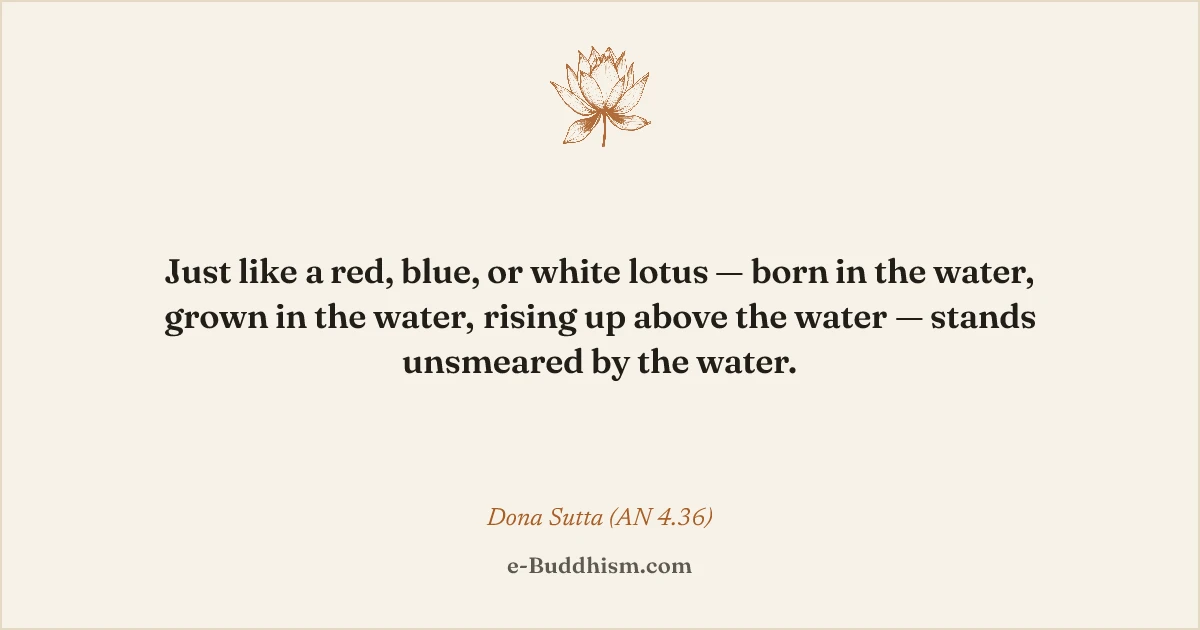
“Just like a red, blue, or white lotus — born in the water, grown in the water, rising up above the water — stands unsmeared by the water…” — The Buddha, Doṇa Sutta (AN 4.36), trans. Thanissaro Bhikkhu
What it means
The full reply completes the simile: “…in the same way I — born in the world, grown in the world, having overcome the world — live unsmeared by the world. Remember me, brahman, as ‘awakened.’”
The point is not withdrawal from the world but freedom within it. The lotus does not grow somewhere cleaner than the mud; it grows in the mud and water and is nourished by them — yet the flower itself is not stained. So too the Buddha: he did not escape ordinary human life but passed through it — birth, ageing, temptation, loss — without being defiled by greed, hatred, and delusion. To be “unsmeared” is to live amid the same conditions as everyone else and not be inwardly soiled by them.
That is also why he refuses every label Doṇa offers (god, celestial musician, spirit, human). He is not claiming to be supernatural. He is saying that awakening is a category of its own — defined not by what kind of being you are but by what you have let go of.
Where it comes from
The exchange is the Doṇa Sutta, the 36th discourse in the Book of the Fours of the Aṅguttara Nikāya (AN 4.36), in the Pali Canon. The brahmin Doṇa, following the Buddha’s road, notices that his footprints bear the mark of a wheel and wonders what manner of being could leave them. The lotus answer is the Buddha’s self-description — one of the few places he plainly says what he is. The translation here is Thanissaro Bhikkhu’s.
Why the lotus
This passage is a key root of the lotus as a Buddhist symbol: purity and awakening rising untouched from the muddy water of ordinary existence. It also tells us something essential about who the Buddha was — not a god to be worshipped, but a human being who woke up, and who pointed others toward the same possibility.
Browse more sourced lines in our Buddhist quotes collection.
Frequently asked questions
Why did the Buddha compare himself to a lotus?
Asked whether he was a god or a man, the Buddha answered that he was neither — he was 'awake' (a buddha). He explained with a lotus: just as a lotus is born and grows in muddy water yet rises above the surface unstained, he was born and grew up in the world yet, having overcome it, lives unsmeared by it. The lotus became Buddhism's enduring symbol of purity rising from the world without being defiled by it.
Where is this lotus quote from?
The Doṇa Sutta, the 36th discourse in the Book of the Fours of the Aṅguttara Nikāya (AN 4.36), part of the Pali Canon. The brahmin Doṇa noticed wheel-marked footprints and asked the Buddha what kind of being he was; this was the reply. The translation is Thanissaro Bhikkhu's.
What does 'buddha' mean here?
When Doṇa asks if he is a deva, a celestial musician, a spirit, or a human, the Buddha says he is none of these, because he has abandoned the mental effluents that would make him any of them. 'Remember me,' he says, 'as awakened' — which is exactly what the word buddha means: one who is awake.
Sources
- Doṇa Sutta (AN 4.36), Access to Insight (trans. Thanissaro Bhikkhu) — https://www.accesstoinsight.org/tipitaka/an/an04/an04.036.than.html