“You Are Your Own Protector” (Dhammapada 160)
We spend a great deal of life hoping to be rescued — by the right person, the right circumstances, the right stroke of luck. The Buddha turns us, gently but firmly, back to ourselves: you are your own protector. Mastered, you become a strength nothing outside you can give. Here is the verse, its meaning, and its source.
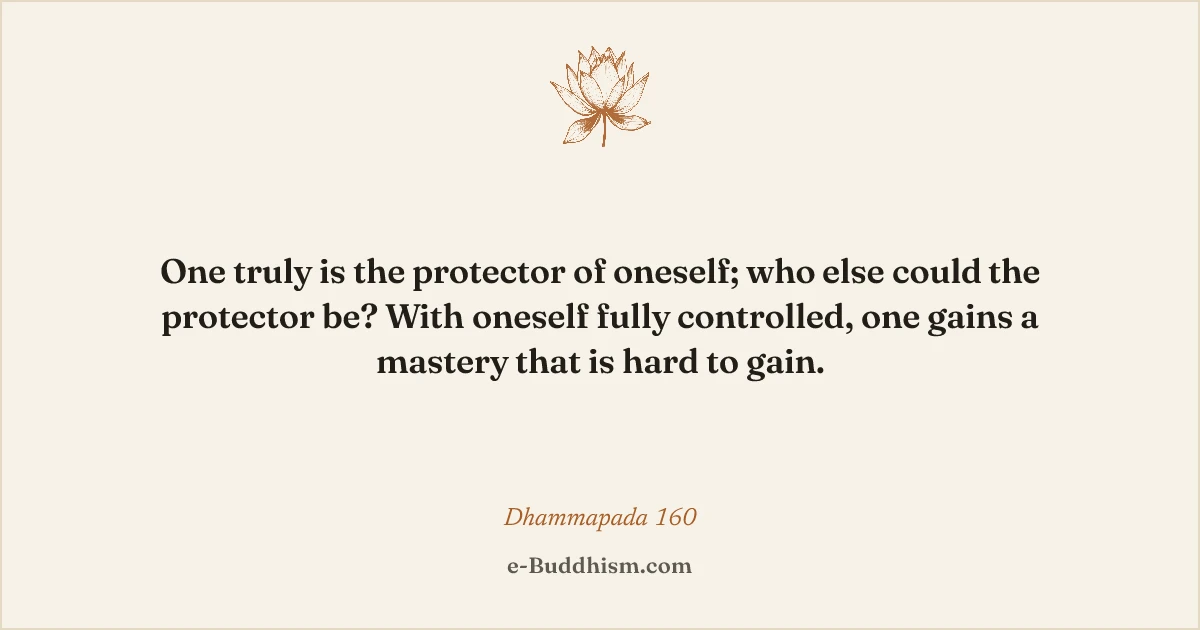
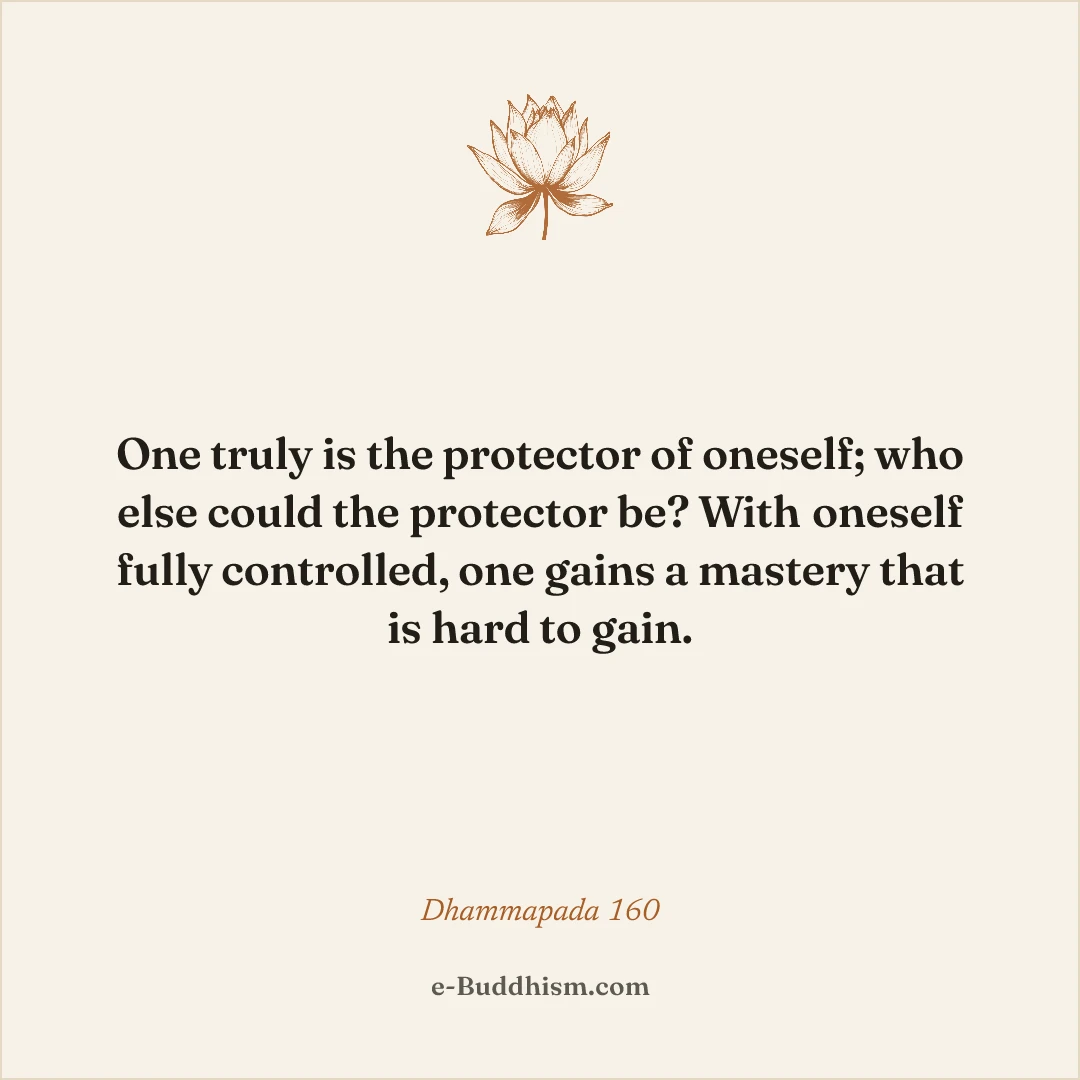
“One truly is the protector of oneself; who else could the protector be? With oneself fully controlled, one gains a mastery that is hard to gain.” — The Buddha, Dhammapada 160 (trans. Acharya Buddharakkhita)
What it means
The first line asks a question that answers itself: “who else could the protector be?” Others can help, comfort, and guide — but no one can stand inside your mind and steady it for you, meet your fears for you, or make your choices for you. In that final, irreducible sense, you are your own refuge. This can feel daunting; it is also the deepest kind of freedom, because it means the one thing you most need is not at the mercy of anyone else.
The second line tells you how that refuge is built: “with oneself fully controlled.” The mastery is inner — a trained, settled, self-possessed mind — and the Buddha is honest that it is “hard to gain.” But it is precisely this self-mastery that makes a person genuinely safe, steady from the inside out rather than propped up from outside.
Where it comes from
Dhammapada 160, from the Attavagga — the chapter “on the Self” — in the Pali Canon. It belongs with its near neighbour, verse 165, on the same theme.
Why it matters
This is the self-reliance that runs through the whole tradition: the Buddha as one who points the way, and each of us as the one who must walk it. It is the companion of “no one can purify another” (Dhp 165) and of the self-mastery praised in “he who conquers himself” (Dhp 103) — and the steadiness it describes is grown in meditation.
Browse more sourced lines in our Buddhist quotes collection.
Frequently asked questions
What does Dhammapada 160 mean?
It points to deep self-reliance: in the end, you are your own protector and refuge — no one else can take that role for you. By mastering yourself ('with oneself fully controlled'), you gain a strength and freedom that nothing external can give. It is the Buddhist version of becoming, finally, your own safe ground.
Doesn't this contradict taking refuge in the Buddha?
No — they fit together. Taking refuge in the Buddha, Dharma, and Sangha means trusting a path and a teacher who point the way. But the Buddha repeatedly said he could only point; the walking is yours. He even told his disciples to 'be islands unto yourselves.' Refuge is guidance; this verse names who must finally do the work.
Where is it from?
Dhammapada 160, from the Attavagga — the chapter 'on the Self' — in Acharya Buddharakkhita's translation. It sits near verse 165 ('no one can purify another'), with which it shares its theme of self-responsibility.
Sources
- Dhammapada 160 (Attavagga), Access to Insight (trans. Acharya Buddharakkhita) — https://www.accesstoinsight.org/tipitaka/kn/dhp/dhp.12.budd.html