Buddha Statue Meaning: Mudras and Poses Explained
A Buddha statue is a kind of language. Its hand gestures, its posture, and even the marks on its body all carry specific meaning — telling you which moment of the Buddha’s life, or which quality of an awakened mind, the image is meant to convey. Learning to “read” a Buddha figure turns a decorative object into a quiet teaching.
The short answer
Every Buddha image encodes meaning through three things: the mudra (hand gesture), the posture, and the traditional marks of a great being. The most common mudras are the earth-touching gesture (the moment of awakening), meditation (hands resting in the lap), teaching (hands at the chest, “turning the wheel”), fearlessness (a raised open palm), and giving (an open downward palm). Posture matters too — seated for meditation, standing for active blessing, reclining for the Buddha’s passing (the parinibbāna, DN 16). The first human Buddha images appeared only around the 1st century CE; before that, symbols stood in for him. And the round, jolly “Laughing Buddha” is not the historical Buddha at all. (Unfamiliar terms are in the glossary.)
In more depth
Reading a Buddha statue
Buddhist art is precise: a Buddha image is composed, not arbitrary. Almost everything about it means something, and to read one you look mainly at three features — the hands, the posture, and the marks on the body. Each is part of a visual vocabulary worked out over many centuries, so that an image could teach the Dharma silently to people who could not read a word of scripture. Once you know the vocabulary, statues that once looked interchangeable begin to tell quite different stories.
The mudras: a language of hands
The mudrās, or ritual hand gestures, are the most expressive element, and the most often asked about. A handful account for the great majority of Buddha images:
- Bhūmisparśa — the earth-touching gesture. The right hand drapes over the knee, fingers reaching down to touch the ground. This is the signature gesture of the awakening: the moment the Buddha-to-be, challenged by Māra, called the earth itself to witness his readiness. It is the single most common mudra in Buddhist art.
- Dhyāna — the meditation gesture. Both hands rest in the lap, the right on the left, palms up, thumbs lightly touching. It signifies meditative absorption and deep calm.
- Dharmachakra — the teaching gesture. Both hands rise to the chest, thumb and forefinger of each forming a circle, evoking the turning of the wheel of Dharma — the Buddha teaching, above all at his first sermon.
- Abhaya — the gesture of fearlessness. The right hand lifts, palm outward, fingers up: “do not be afraid.” It offers protection, reassurance, and peace.
- Varada — the gesture of giving. An open palm faces outward and downward, signifying generosity, compassion, and the granting of wishes.
Each gesture freezes a specific moment or quality, so the hands are usually the fastest way to read what a given image is “about.”
The postures
The body’s overall pose carries its own meaning:
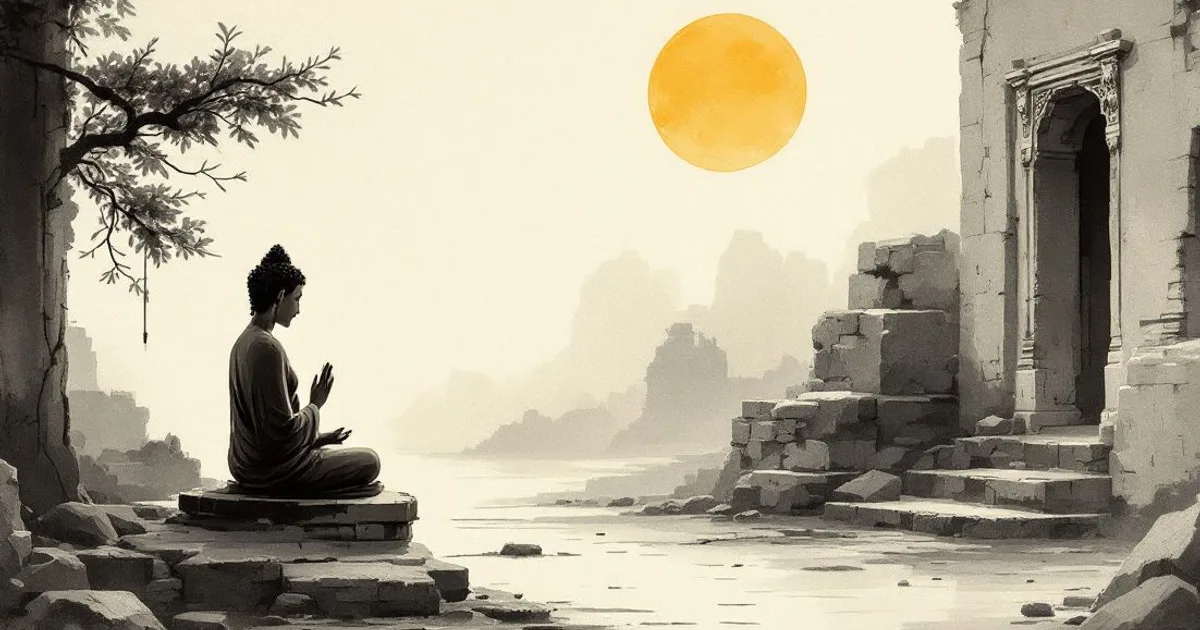
- Seated — most often cross-legged in a meditation posture. This is the most common form, used for the awakening, for meditation, and for teaching.
- Standing — the Buddha upright, often in the fearlessness or giving gesture: the awakened one active in the world, blessing and teaching.
- Reclining — lying on the right side, head resting on the hand. This depicts the parinibbāna, the Buddha’s passing into final nibbāna between two sal trees, as told in the Mahāparinibbāna Sutta (DN 16). Crucially, the face is serene: this is not death in fear or grief but the lying-down of a being who has wholly ended suffering.
- Walking — less common, and especially refined in Thai art: the Buddha in gentle motion, journeying to teach.
The marks of a great being
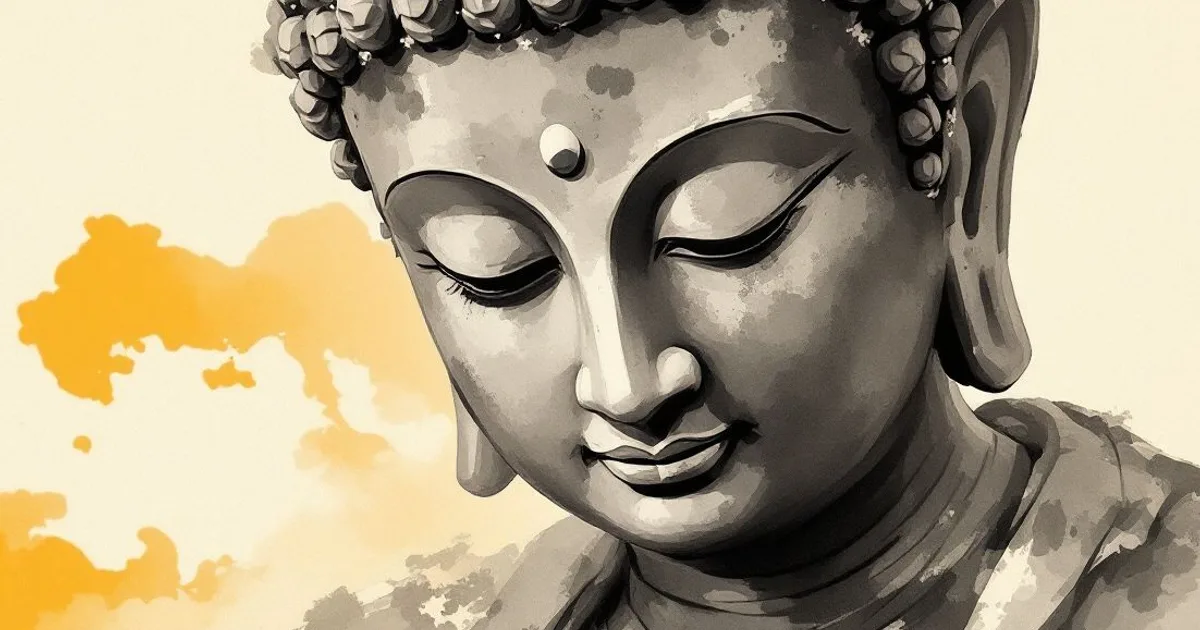
Buddha images also carry a set of traditional bodily signs, drawn from an ancient list of the “thirty-two marks of a great being.” The most visible are the ushnisha, the bump or topknot on the crown of the head, signifying expanded wisdom; the urna, a dot or curl of hair between the brows, a mark of insight; and the notably elongated earlobes, which recall the heavy jewelled earrings the prince once wore and then renounced — a quiet reminder of his going forth. Add the tightly curled hair, the half-closed eyes resting in inward calm, and the faint smile, and you have not a realistic portrait but a deliberate image of an awakened being.
Where Buddha images came from
It is worth knowing that the Buddha figure is not original to Buddhism. For its first several centuries, Buddhist art was aniconic — it did not show the Buddha in human form at all, but pointed to him through symbols like the wheel, the empty throne, and the Bodhi tree. The familiar statue came later. As Encyclopaedia Britannica notes, the schools of Gandhāra and Mathurā “each independently evolved its own characteristic depiction of the Buddha about the 1st century ce,” with the Gandhāra school, under Greco-Roman influence, giving him “a youthful Apollo-like face, dressed in garments resembling those seen on Roman imperial statues.” From those beginnings each Buddhist culture developed its own style — the Hellenistic drapery of Gandhāra, the fuller Indian forms of Mathura, and later the distinctive images of Thailand, Tibet, China, and Japan.
The “Laughing Buddha” is not the Buddha
One clarification saves a great deal of confusion. The plump, jolly, bald figure with a big bare belly and a cloth sack — the “Laughing Buddha” found in restaurants, gift shops, and gardens — is not Siddhartha Gautama, the historical Buddha. He is Budai (in Chinese) or Hotei (in Japanese), a legendary, good-natured Chinese monk associated with contentment, abundance, and good luck, who came to be regarded as an emanation of Maitreya, the buddha yet to come. The historical Buddha, by contrast, is depicted as serene and slender, often deep in meditation. The two are entirely different figures, and the mix-up is one of the most common in popular culture. (For the full story, see why the Laughing Buddha is fat.)
Are Buddha statues worshipped?
Because Buddhists bow before Buddha images and set offerings of flowers, incense, and light before them, outsiders often ask whether this is idol worship. The tradition’s own understanding is generally otherwise: the gestures express respect and gratitude toward what the Buddha represents, and the image serves as a support for the mind — a reminder and an inspiration — rather than an idol believed to house a god. Theravāda is explicit that the Buddha is “gone” in parinibbāna and not present in the statue; Mahāyāna devotion can feel warmer and more personal. Either way, the bow is closer to the respect one offers a great teacher than to the worship of a deity. (We explore this fully in our guide to whether Buddhists pray.)
Living with a Buddha image
Many people like to keep a Buddha image at home, and a little respect goes a long way. The traditional instinct is simply to treat the image as one would treat the teaching it honours: give it a clean, raised, dignified place rather than the floor or a cluttered corner, and let it serve as a calm focal point — for a breath, a bow, or a moment of stillness — rather than mere decoration. Read rightly, a Buddha statue is a silent teaching: the hands, the posture, and the quiet face all pointing back to the awakening they depict. The same reverence explains why a Buddha image tattooed disrespectfully can cause real offense — see can Buddhists have tattoos? (For the wider language of Buddhist imagery, see Buddhist symbols and their meanings.)
Frequently asked questions
How do you read the meaning of a Buddha statue?
By looking at three things: the hand gesture (mudra), the posture, and the traditional marks of a great being. Each carries a fixed meaning. The right hand reaching down to touch the earth signals the moment of awakening; hands resting in the lap signal meditation; a reclining figure shows the Buddha's passing. Once you know the vocabulary, a Buddha image reads like a sentence.
What do the Buddha's hand gestures (mudras) mean?
The main mudras are: bhumisparsha, the earth-touching gesture (the moment of awakening); dhyana, hands in the lap (meditation); dharmachakra, hands at the chest (teaching, 'turning the wheel'); abhaya, a raised open palm (fearlessness and reassurance); and varada, an open downward palm (generosity and compassion). Each freezes a particular moment or quality of the Buddha.
What does a reclining Buddha statue mean?
A reclining Buddha — lying on his right side, head propped on his hand — depicts the parinibbana, the Buddha's serene passing into final nibbana between two sal trees, as described in the Mahaparinibbana Sutta (DN 16). It is not an image of ordinary death or sorrow but of a being who has completely ended suffering, lying down in perfect peace.
Is the Laughing Buddha the same as the Buddha?
No. The fat, jolly, bald figure with a big belly and a cloth sack — the 'Laughing Buddha' seen in shops and restaurants — is not Siddhartha Gautama, the historical Buddha. He is Budai (Chinese) or Hotei (Japanese), a legendary monk associated with contentment and good fortune, later regarded as an emanation of Maitreya, the future Buddha. The historical Buddha is depicted as serene and slender.
Do Buddhists worship Buddha statues?
Buddhists bow and make offerings before Buddha images, which can look like worship, but the tradition generally understands this as respect and gratitude toward what the Buddha represents — and as a support for the mind in practice — rather than the worship of an idol believed to contain a god. Theravada regards the Buddha as 'gone' and not present in the image; Mahayana devotion can be warmer, but the statue remains a reminder, not a deity.
Sources
- Gandhāra art (entry), Encyclopædia Britannica
- Mahāparinibbāna Sutta (DN 16), Access to Insight (trans. Sister Vajirā & Francis Story)