Buddhist Symbols and Their Meanings
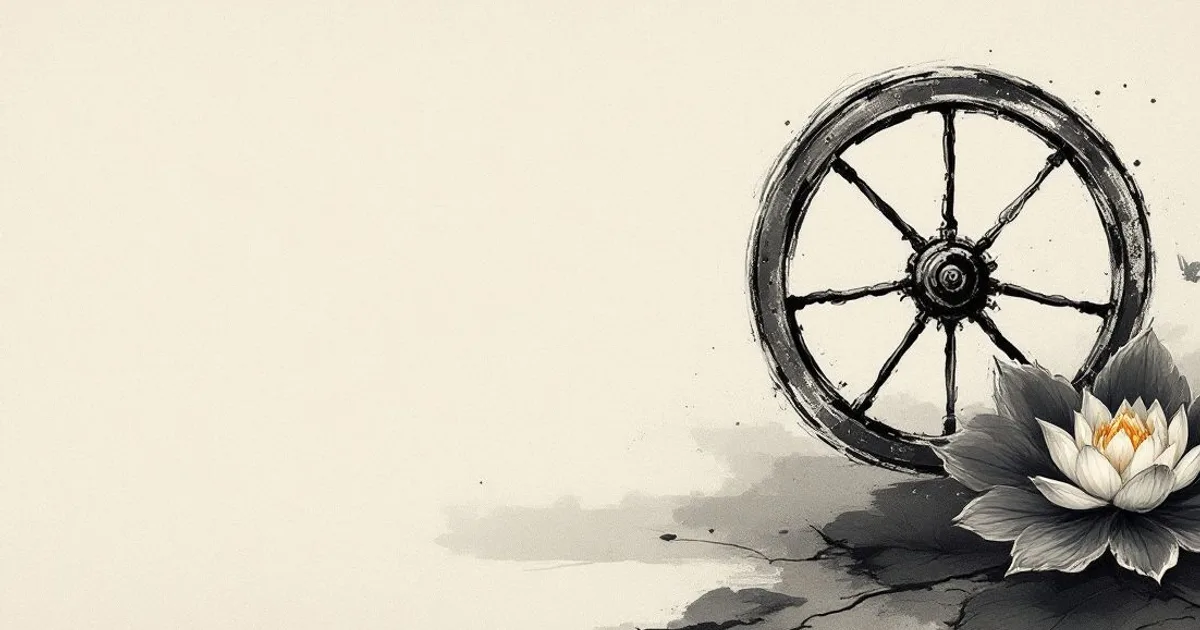
Buddhism is rich in symbols — the lotus, the wheel, the endless knot, the Buddha image itself — and each is a kind of visual shorthand for a teaching. Remarkably, the earliest Buddhist art showed the Buddha only through symbols, never in human form. This is a guide to the most important Buddhist symbols and what they have traditionally been understood to mean.
The short answer
The central Buddhist symbols are the Dharma wheel (dharmachakra — the Buddha’s teaching and the Noble Eightfold Path), the lotus (purity rising from the mud), and the classic set of Eight Auspicious Symbols (ashtamangala) most prominent in Tibetan Buddhism: the parasol, a pair of golden fish, the treasure vase, the lotus, the conch shell, the endless knot, the victory banner, and the wheel. Other major symbols include the Buddha image, the Bodhi tree (his awakening), the stupa, and the Zen ensō (a single brushed circle — and this site’s own mark). To Buddhists these are not idols but pointers — reminders of a teaching, supports for practice. (Unfamiliar terms are in the glossary.)
In more depth
Before images: the aniconic Buddha
One of the most surprising facts about Buddhist art is that, for its first few centuries, it did not depict the Buddha in human form at all. Instead, artists pointed to him through signs — an empty throne, a pair of footprints, a parasol held over an absent figure, a wheel, the Bodhi tree, a stupa — marking his presence precisely by his bodily absence. The familiar Buddha figure came later. As Encyclopaedia Britannica notes, the schools of Gandhāra and Mathurā “each independently evolved its own characteristic depiction of the Buddha about the 1st century ce,” with the Gandhāra school, under Greco-Roman influence, giving him “a youthful Apollo-like face, dressed in garments resembling those seen on Roman imperial statues.” Buddhist symbolism, in other words, is older than the Buddha image — the symbols carried the teaching before any face did, which is part of why they matter so deeply.
The Dharma Wheel (Dharmachakra)
The single most important Buddhist symbol is the Dharma wheel, which Britannica calls “the wheel of the law.” It stands for the Buddha’s teaching as a whole, and for the moment he first “set the wheel of Dharma in motion” at his first sermon. Its parts are read as a teaching in themselves: the hub is moral discipline (the still centre that everything turns on), the rim is the mindfulness and concentration that hold the whole together, and the spokes — most often eight of them — are the Noble Eightfold Path. And the very fact that it is a wheel, something that rolls forward, suggests a living teaching meant to move out through the world. It is among the oldest of all Buddhist symbols, and a version of it (the Ashoka Chakra) sits at the centre of the national flag of India. (See our full guide to the Dharma wheel.)
The Lotus (Padma)
If the wheel is the most important symbol, the lotus is the most beloved. The lotus takes root in the mud at the bottom of a pond, grows up through the murky water, and opens its blossom immaculate and dry above the surface — and in that simple natural fact Buddhism found a perfect image of the path. The flower is purity and awakening rising, unstained, out of the mud of ordinary worldly existence. The awakened mind, like the lotus, grows from the world of confusion and craving yet is not dirtied by it. Colour adds nuance — white for purity, pink often for the Buddha himself, blue for wisdom, red for compassion and love — and buddhas and bodhisattvas are very often shown seated or standing upon a lotus throne, serene above the waters. (See our full guide to the lotus flower in Buddhism.)
The Eight Auspicious Symbols (Ashtamangala)
The ashtamangala are a set of eight signs of good fortune, especially prominent in Tibetan and Indian Buddhism, where they are often depicted together as a group and offered as a blessing. Each carries a traditional meaning:
- The parasol (chatra) — royalty and protection; the cool shelter of the Dharma against the heat of suffering.
- The pair of golden fish — freedom and fearlessness, moving easily through the water as the awakened move through the ocean of existence without drowning in it.
- The treasure vase — the inexhaustible riches and spiritual abundance of the teaching.
- The lotus — purity and awakening, as above.
- The conch shell (white, spiralling to the right) — the deep, far-carrying sound of the Dharma, proclaimed in every direction.
- The endless knot (śrīvatsa) — the interweaving of all things: wisdom and compassion bound together, and the dependent, beginningless-and-endless nature of reality.
- The victory banner — the Buddha’s victory over Māra, over ignorance and death.
- The Dharma wheel — the teaching itself.
The Buddha image and the mudrās
Once it appeared, the Buddha figure became a symbol in its own right — and its hand gestures, called mudrās, form a precise visual language. The right hand reaching down to touch the earth is the earth-touching gesture, recalling the moment the Buddha called the earth to witness at his awakening; hands turning at the chest form the teaching gesture (“turning the wheel”); hands resting in the lap signify meditation; an open raised palm offers fearlessness and reassurance. To “read” a Buddha statue is largely to read its hands and posture. (See our full guide to reading a Buddha statue’s mudras and poses.)
The Bodhi Tree
The Bodhi tree — the ficus religiosa under which the Buddha sat through the night of his enlightenment at Bodh Gayā — is itself a major symbol of awakening. Living descendants of the tradition’s original tree are venerated to this day at Bodh Gayā and in Sri Lanka, and the heart-shaped leaf is a quiet emblem of the awakened mind.
The Stupa
The stupa is the dome-shaped monument that, in its origins, enshrined relics of the Buddha. Over time it became a symbol of the Buddha’s awakened mind and of the path itself, its tiers sometimes read as the stages of the way to enlightenment. Across Asia the form evolved into the East Asian pagoda. Walking slowly around a stupa, keeping it on one’s right, is among the most widespread of all Buddhist devotional practices. (See our full guide to stupas and pagodas.)
The Mandala
A mandala is a sacred diagram of the cosmos — a centre encircled by rings and a four-gated square — used as a map of reality and an instrument of meditation, most elaborately in Tibetan Buddhism. Its most famous form, the sand mandala, is built grain by painstaking grain and then deliberately swept away — a teaching in impermanence made visible. (See our full guide to Buddhist mandalas.)
The Ensō
In Zen, the ensō is a circle drawn in a single, uninhibited brushstroke. At once empty and full, finished and unfinished, it expresses the Zen taste for the present moment, for emptiness, and for a perfection that includes imperfection. (It is the mark this very site takes for its own.)
A word on the swastika
It is worth addressing one symbol honestly, because it so often confuses Western visitors. The swastika is an ancient sign of auspiciousness, eternity, and well-being, used across Asian and many world cultures for thousands of years. It appears throughout Buddhism — frequently on the Buddha’s chest or feet, or as a decorative border — where it signifies good fortune and the Buddha’s heart-mind. This usage is millennia old and entirely distinct from, and long predates, the symbol’s appropriation by the Nazis in the 20th century. Encountering it on a temple or a Buddha statue, one is seeing the older, benevolent meaning; knowing the difference is part of cultural literacy.
Why symbols matter in Buddhism
For all their beauty, Buddhist symbols are not objects of worship in themselves. They are pointers — visual teachings, reminders, and supports for the mind. A wheel recalls the path; a lotus, the possibility of purity even here; a stupa, the goal; a single brushed circle, this very moment. They let the Dharma speak without words, across languages and across centuries, to anyone willing to look. (For the teachings the symbols point to, see the core teachings of Buddhism; for the path the wheel represents, the Noble Eightfold Path.)
Frequently asked questions
What are the main Buddhist symbols?
The most important include the Dharma wheel (dharmachakra), representing the Buddha's teaching; the lotus, representing purity rising from the mud; and the classic set of Eight Auspicious Symbols (ashtamangala) — the parasol, a pair of golden fish, the treasure vase, the lotus, the conch shell, the endless knot, the victory banner, and the wheel. Other major symbols are the Buddha image itself, the Bodhi tree, the stupa, and the Zen ensō (circle).
What does the Dharma wheel symbolize?
The Dharma wheel (dharmachakra), which Britannica calls 'the wheel of the law,' represents the Buddha's teaching and its first 'setting in motion' at his first sermon. Its eight spokes most commonly stand for the Noble Eightfold Path, the hub for moral discipline, and the rim for the mindfulness that holds practice together. That it is a wheel — something that turns — suggests a teaching meant to move through the world.
What does the lotus flower mean in Buddhism?
The lotus grows from mud at the bottom of a pond and rises to open, immaculate, above the water — so it became Buddhism's image of purity and awakening emerging unstained from the mud of worldly existence. The awakened mind, like the lotus, is untouched by the defilements it grows beyond. Different colours carry shades of meaning, and buddhas are often shown seated on a lotus throne.
What are the eight auspicious symbols?
The ashtamangala, a set especially prominent in Tibetan Buddhism, are eight signs of good fortune often shown together: the parasol (protection), a pair of golden fish (freedom and fearlessness), the treasure vase (inexhaustible riches of the teaching), the lotus (purity), the conch shell (the sound of the Dharma), the endless knot (the interweaving of all things), the victory banner (the Buddha's victory over ignorance), and the Dharma wheel (the teaching).
Is the Buddhist swastika the same as the Nazi symbol?
No. The swastika is an ancient symbol of auspiciousness and well-being used across Asia for thousands of years, and it appears in Buddhism — often on the Buddha's chest or as a decorative motif — long predating and entirely distinct from its appropriation by the Nazis in the 20th century. In Buddhist contexts it signifies good fortune, eternity, and the Buddha's mind or footprints.
Sources
- Gandhāra art (entry), Encyclopædia Britannica
- Dharmachakra (entry), Encyclopædia Britannica