“Cover Your Own Feet”: Shantideva on Guarding the Mind
We exhaust ourselves trying to make the world safe — smoothing every circumstance so nothing can hurt us. Shantideva offers a wiser, funnier image: you can’t carpet the whole earth in leather, but you can cover your own feet — and then it’s as if the whole earth were soft. Guard your mind, not the world. Here is the verse, its meaning, and its source.
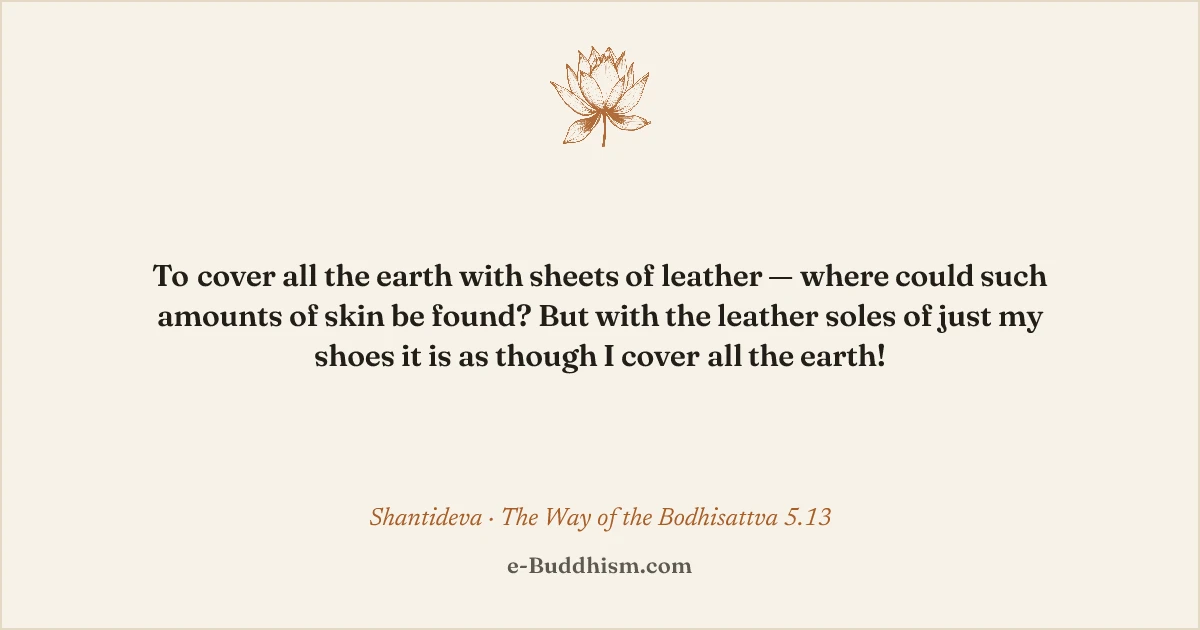
“To cover all the earth with sheets of leather — where could such amounts of skin be found? But with the leather soles of just my shoes it is as though I cover all the earth!” — Shantideva, The Way of the Bodhisattva 5.13 (trans. Padmakara Translation Group)
What it means
The picture is almost comic, and that is the point. Imagine trying to protect your feet by paving the entire planet in leather — every road, field, and mountain. Where would you find that much hide? It is an impossible, exhausting, endless task. Then the turn: but a little leather on the soles of your shoes, and “it is as though I cover all the earth.” The same protection, achieved by the opposite strategy — covering yourself rather than the world.
Shantideva is talking about the mind. We spend our lives trying to arrange external conditions so that nothing can disturb us — the right job, the right people, every situation managed so it can’t upset us. It never quite works, because the “ground” is infinite; there is always more world to control. The verse points to the one thing that is in our power: our own reactive mind. Guard that — train it, steady it — and you are, in effect, protected wherever you walk. You carry the soft ground with you.
This is not passivity about the world; it is realism about where our leverage actually lies. The whole chapter it comes from is about guarding awareness — watching the mind closely, since that is the gate through which all suffering and freedom pass.
Where it comes from
The verse is 5.13 of the Bodhicaryāvatāra (“The Way of the Bodhisattva”), by Shantideva, the 8th-century monk of Nālandā, from the chapter on guarding awareness. The poem is central to Mahāyāna and Tibetan Buddhism; the wording is the Padmakara Translation Group’s. The image has travelled far beyond Buddhism — it turns up, among other places, in modern self-help.
Why it matters
This is one of the most practical pieces of advice in all of Buddhism, and a close cousin of letting go of what was never in our control. It comes from the same author as the much-misquoted verse on worry, “if there’s a remedy, why be unhappy?” — both point the mind back to the small, real circle of what it can actually change.
Browse more sourced lines in our Buddhist quotes collection.
Frequently asked questions
What does Shantideva's leather-shoes verse mean?
You cannot pave the whole world in leather to protect your feet — there isn't enough hide, and you can't control all the ground you'll ever walk on. But you can cover your own two feet, and then it's 'as though' the whole earth is soft. The teaching: don't try to control every external condition; guard your own mind instead, and you are protected everywhere you go.
How does it apply to daily life?
We spend enormous energy trying to rearrange the world so nothing can upset us — smoothing every circumstance, managing every person. It never quite works; the ground is endless. Shantideva points to the one thing actually in our power: our own reactive mind. Guard that, and you carry your peace with you, whatever ground you cross.
Where is it from?
Shantideva's Bodhicaryāvatāra ('The Way of the Bodhisattva'), verse 5.13, in the chapter on guarding awareness — translated here by the Padmakara Translation Group. The image is so apt it has been borrowed widely, including in modern self-help.
Sources
- Shantideva, The Way of the Bodhisattva (Bodhicaryāvatāra) 5.13, trans. Padmakara Translation Group (Shambhala, rev. ed. 2006).