Prayer Flags and Prayer Wheels: How They Work
Tibetan prayer flags and prayer wheels are two of Buddhism’s most recognisable devotional objects — strings of colourful flags fluttering across a mountain pass, and bright cylinders spun by a passing hand. Both work on the same quietly beautiful idea: that a printed prayer or mantra, set in motion by the wind or the turn of a hand, sends its blessing out into the world.
The short answer
Prayer flags are cloth squares printed with mantras and prayers, strung outdoors so that the wind carries their blessings to all beings; their five colours represent the five elements. Prayer wheels are, in Britannica’s words, “a hollow metal cylinder … containing a tightly wound scroll printed with a mantra” — and “each turning of the wheel by hand is equivalent in efficacy to the prayer’s oral recitation multiplied by the number of times the mantra is printed on the scroll.” Both belong to Tibetan (Vajrayana) Buddhism, and both most often carry the mantra Om mani padme hum. The shared idea is lovely in its simplicity: prayer is not to be hoarded but released — onto the wind, into the turning — to bless everything it touches. (Unfamiliar terms are in the glossary.)
In more depth
Prayer flags: prayers on the wind
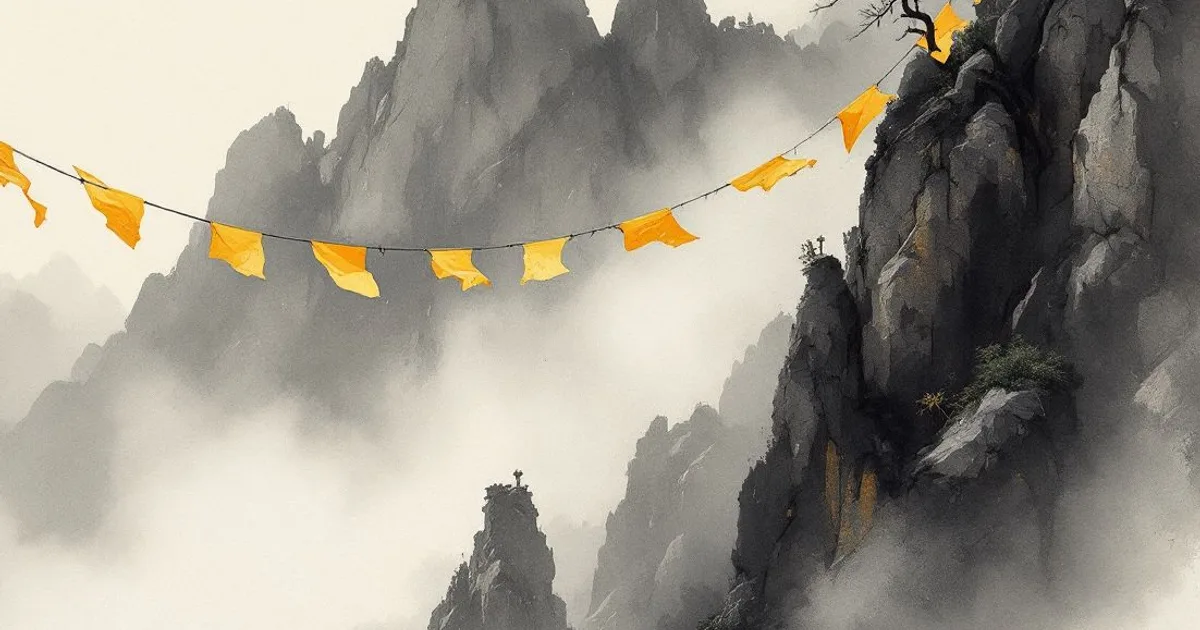
Across the Tibetan and Himalayan world, strings of small cloth flags flutter from rooftops, bridges, stupas, and high mountain passes. Each flag is woodblock-printed with mantras, prayers, and auspicious images — frequently the “wind horse” (lung ta), a horse bearing a wish-fulfilling jewel, at the centre. Traditionally the flags come in repeating sets of five colours in a fixed order — blue, white, red, green, and yellow — standing for the five elements: space, air, fire, water, and earth, and the harmony among them.
The meaning is in the movement. As the wind passes through the flags, it is said to carry the prayers and blessings printed on them out across the whole landscape, to every being the wind reaches. This is the key to the practice: the flags are hung not to petition for oneself but to bless all beings — a generous, outward-facing devotion. And as they fade and fray in the sun and weather, that weathering is not neglect but part of the point: the prayers are being carried off into the world, and the slow disintegration is itself a reminder of impermanence. Rather than take the old flags down, people hang fresh ones beside them, so the blessing is continually renewed — most of all at Losar, the Tibetan New Year, when raising fresh flags is a customary way to renew one’s fortune for the year ahead.
Prayer wheels: prayer in motion
A prayer wheel applies the same idea to the turn of a hand. Britannica describes it as “a hollow metal cylinder, often beautifully embossed, mounted on a rod handle and containing a tightly wound scroll printed with a mantra.” You spin it — clockwise, following the sun’s path — and the logic is explicit: “each turning of the wheel by hand is equivalent in efficacy to the prayer’s oral recitation multiplied by the number of times the mantra is printed on the scroll.” A cylinder packed with thousands of printed copies of a mantra therefore “recites” it thousands of times with a single turn.
Prayer wheels come in many sizes: small handheld ones weighted to spin easily, long rows of larger wheels set into temple walls to be brushed into motion as pilgrims walk past, and — as Britannica notes — even great “cylinders that can be attached to windmills or waterwheels and thus kept in continuous motion,” so that prayer turns on, day and night, by itself. The mantra inside is most often Om mani padme hum, the mantra of Avalokiteśvara, whom Britannica calls the bodhisattva “of infinite compassion and mercy” — so the wheel sends compassion itself circulating into the world. (We say more about that mantra in our guide to whether Buddhists pray.)
The idea behind them
To an outside eye, a machine that “says” prayers can look like a shortcut or a superstition, and it is worth meeting that honestly. The practice rests on a coherent idea: a mantra is a sacred sound and a blessing, and to circulate it — by voice, by wind, by hand, by flowing water — is to spread its benefit. Turning a prayer wheel is also a focusing practice for the person who turns it: a physical prayer that steadies and gathers the mind, much as telling beads on a mala does. And, crucially, the prayers are characteristically offered for the welfare of all beings, not for private wishes — so the whole apparatus is an act of generosity rather than a personal request. Whether a given practitioner takes the “efficacy” literally or holds it more as a meditative support, the spirit is the same: compassion set in motion. (Different Buddhists hold these practices in different ways, and that is fine.)
Where they belong
Prayer flags and prayer wheels are part of the rich devotional life of Tibetan Buddhism, alongside mantras, mandalas, and prayer beads — the material culture of a tradition that deliberately engages body, speech, and mind together rather than the mind alone. Between them, they turn the whole environment into an instrument of blessing: the wind through the flags, the water under the wheel, the turn of a hand in passing. There is something gently radical in the underlying conviction — that a prayer is most itself not when it is kept, but when it is let go, released to bless everything it can reach. (For the wider family of Buddhist symbols, see our overview.)
Frequently asked questions
What do Tibetan prayer flags mean?
Prayer flags are colourful cloth squares printed with mantras, prayers, and auspicious symbols, strung outdoors across rooftops, bridges, and mountain passes. As the wind blows through them, it is said to carry their blessings out across the land to all beings. They are hung not for personal gain but to bless everyone the wind reaches — an outward, generous form of devotion most associated with Tibetan Buddhism.
What do the colours of prayer flags mean?
Traditionally prayer flags come in sets of five colours in a fixed order — blue, white, red, green, and yellow — representing the five elements: blue for space or sky, white for air or wind, red for fire, green for water, and yellow for earth. Arranged together, they symbolize balance and harmony among the elements.
How does a Buddhist prayer wheel work?
Britannica describes a prayer wheel as 'a hollow metal cylinder … containing a tightly wound scroll printed with a mantra.' You spin it by hand, and 'each turning of the wheel by hand is equivalent in efficacy to the prayer's oral recitation multiplied by the number of times the mantra is printed on the scroll.' A wheel packed with thousands of copies of a mantra therefore 'recites' it thousands of times with a single turn.
Which way do you spin a prayer wheel?
Clockwise — the traditional direction, which follows the apparent path of the sun and matches the direction in which Buddhists circumambulate a stupa or shrine. Prayer wheels range from small handheld ones to large cylinders lining temple walls, and even giant versions that, as Britannica notes, can be turned continuously by wind or water.
Why are old prayer flags left to fade?
The fading is part of the meaning, not neglect. As the flags weather and fray, the wind is said to carry their prayers out into the world, and their gradual disintegration is a natural reminder of impermanence. Rather than removing old flags, practitioners often hang fresh ones alongside them, so that the blessing — and life itself — keeps renewing.
Sources
- Prayer wheel (entry), Encyclopædia Britannica
- Avalokiteśvara (entry), Encyclopædia Britannica