Buddhism in Sri Lanka: The Theravada Heartland
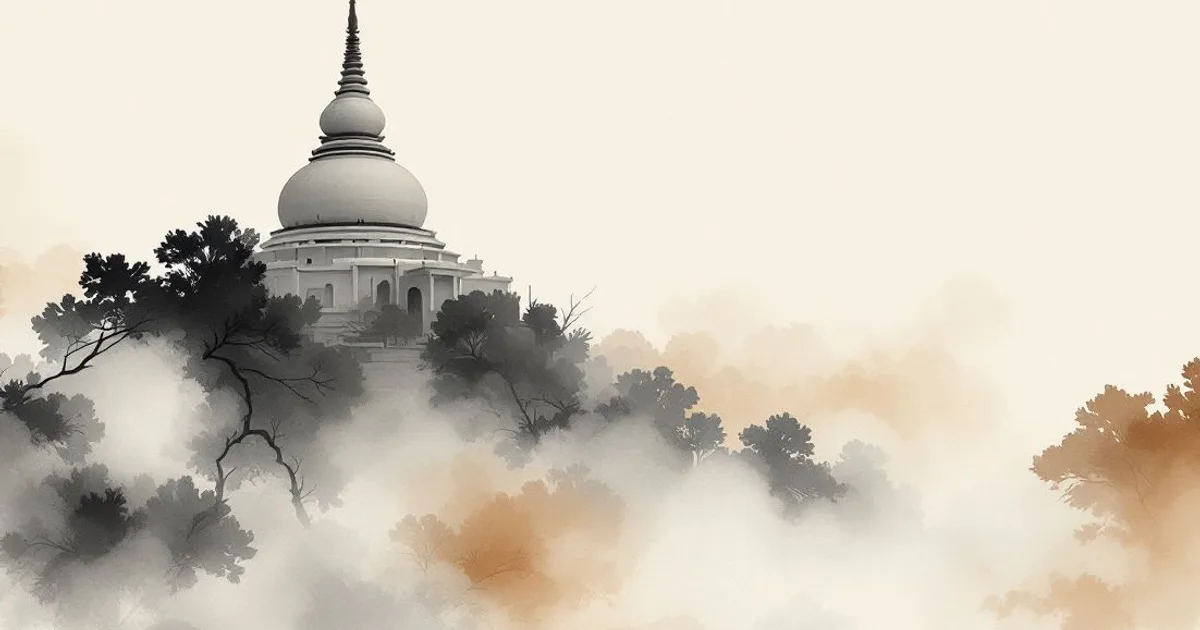
Buddhism in Sri Lanka is overwhelmingly Theravada, the oldest surviving school — and the island is its historic heartland. About 70% of Sri Lankans are Buddhist (2012 census), the tradition arrived in the 3rd century BCE, and it was here, uniquely, that the Pali Canon was first written down. Few countries are so bound up with the Dharma.
The short answer
Sri Lanka is where Theravada Buddhism has been continuously preserved for more than two thousand years, longer than anywhere else on earth. Roughly 70% of the population is Buddhist — 70.2% in the 2012 national census — making it one of only seven Buddhist-majority countries in the world. What makes the island historically central is not just its numbers but its role as the tradition’s guardian: this is the land where the Buddha’s teachings were first entrusted to writing, where an unbroken monastic lineage was maintained, and from which Theravada was later carried to Thailand, Myanmar, Cambodia and Laos. To understand Sri Lankan Buddhism is to look at the root system of the whole “Southern” tradition — one of the three great branches of Buddhism. (Unfamiliar terms are explained in the glossary.)
How Buddhism came to the island
The story of Buddhism’s arrival is told in the Mahāvaṃsa, Sri Lanka’s “Great Chronicle,” and it is one of the most consequential missions in Buddhist history. In the 3rd century BCE, during the reign of the Indian emperor Ashoka — Buddhism’s great royal patron — a monk named Mahinda, described in the chronicles as Ashoka’s own son, brought the teaching to the island. As Encyclopaedia Britannica records, Mahinda met and converted the Sinhalese king Devānampiya Tissa near the capital, Anuradhapura.
The king embraced the new faith and gave it a home. He established the Mahāvihāra (“Great Monastery”) at Anuradhapura, which became the institutional centre of Theravada orthodoxy for the next millennium. Soon after, Mahinda’s sister, the nun Saṅghamittā, is said to have travelled from India bearing a cutting of the very Bodhi tree under which the Buddha awakened at Bodh Gaya. Planted at Anuradhapura as the Jaya Sri Maha Bodhi, that tree still stands and is venerated today — often described as one of the oldest human-planted trees with a recorded planting. This is how a north Indian teaching became the heart of an island civilisation, a story that belongs to the wider account of how Buddhism spread.
The island that wrote down the Canon
Sri Lanka holds a place in Buddhist history that no other country can claim: it is where the scriptures were first committed to writing.
For centuries after the Buddha’s death, his discourses were preserved orally, memorised and chanted by communities of monks. According to the tradition, in the 1st century BCE — during a time of famine and war that threatened to break the chain of memorisation — the monks of Sri Lanka gathered to write the entire Pali Canon (the Tipiṭaka, “Three Baskets”) down onto palm leaves. This is traditionally located at the Aluvihāra cave temple near Matale, under the reign of King Vaṭṭagāmaṇi (Valagamba). (The exact year is given traditionally as around 29 BCE; careful histories say simply “the 1st century BCE.”)
The importance of this is hard to overstate. The oldest complete collection of the Buddha’s teachings that survives — the textual foundation of Theravada across the world — exists because of what was done on this island. Sri Lanka became, and remains, the guardian of the Pali tradition, and its great commentator Buddhaghosa (5th century CE) worked here, composing the Visuddhimagga and organising the commentaries that shape Theravada study to this day.
Sacred places and living devotion
Sri Lankan Buddhism is not only ancient texts; it is a vivid landscape of pilgrimage and daily practice.
- The Sacred City of Anuradhapura — the ancient capital, a UNESCO World Heritage site, home to the Sri Maha Bodhi tree and colossal dagobas (stupas) such as the Ruwanwelisaya, built by the hero-king Dutugemunu.
- The Temple of the Sacred Tooth Relic (Sri Dalada Maligawa) in Kandy — the country’s most revered shrine, housing a relic honoured as a tooth of the Buddha. Said to have reached the island in the 4th century CE, the tooth relic became a symbol of sovereignty itself: to guard it was to hold the right to rule. Its annual procession, the Esala Perahera, is one of Asia’s great religious festivals.
- Polonnaruwa and the rock temples of Dambulla — later capitals and cave-shrines whose serene stone Buddhas are among the masterpieces of Buddhist art.
Everyday devotion runs through poya (full-moon) days, temple offerings of flowers and light, the chanting of pirith (protective verses) for blessing and protection, and the support of the monastic Sangha — organised here into monastic fraternities (nikāyas) such as the Siyam, Amarapura and Rāmañña. It is a Buddhism woven, much as in Thailand, into the rhythm of ordinary life.
Buddhism and Sinhalese identity: an honest note
No account of Sri Lankan Buddhism would be complete — or honest — without acknowledging that the tradition has become deeply intertwined with Sinhalese ethnic identity, and that this has had difficult consequences worth stating plainly and carefully.
Sri Lanka endured a long and painful civil war (1983–2009) between the state, dominated by the Sinhalese Buddhist majority, and the Liberation Tigers of Tamil Eelam (LTTE), who fought for a separate homeland for the Tamil minority. It is important not to misread this as a religious war between Buddhists and Hindus. Though most Sinhalese are Buddhist and most Tamils are Hindu, the conflict was ethnic and political — rooted in questions of language (such as the 1956 “Sinhala Only” Act), territory and power, not in doctrinal dispute. Flattening it into “Buddhists versus Hindus” would be inaccurate.
Separately, more recent years have seen a strand of Sinhala-Buddhist nationalism, including groups such as Bodu Bala Sena (“Buddhist Power Force,” formed 2012), whose anti-Muslim rhetoric has been linked to episodes of communal violence. This is a minority extremist current, not the outlook of the mainstream Sangha or of most Sri Lankan Buddhists, and many Buddhist leaders have spoken against it. We note it here because this site’s commitment is to honesty: a tradition can be both a profound spiritual path and, in some hands, entangled with nationalism — and saying so clearly is part of respecting it.
Sri Lanka among the traditions
Sri Lanka is the taproot of Theravada Buddhism: the island that preserved the Pali Canon, maintained an unbroken monastic lineage, and carried the “Southern” tradition to mainland Southeast Asia. To see its Buddhism is to see the conservative, text-centred stream in its oldest continuous form — a living link back to the earliest recorded teaching. For the doctrinal foundations, see our guide to Theravada Buddhism; for its sister Theravada nations, Buddhism in Thailand and Buddhism in Myanmar; and for the full global map, Buddhism around the world and the branches of Buddhism.
Frequently asked questions
What percentage of Sri Lanka is Buddhist?
About 70% of Sri Lanka's population is Buddhist — 70.2% in the 2012 national census — and almost all of it is Theravada, the oldest surviving school. Buddhists are the country's largest religious community, followed by Hindus, Muslims and Christians. Sri Lanka is one of only seven countries in the world with a Buddhist majority.
How did Buddhism come to Sri Lanka?
By tradition, Buddhism was brought to the island in the 3rd century BCE by the monk Mahinda, described in the Sri Lankan chronicles as the son of the Indian emperor Ashoka. Mahinda converted King Devānampiya Tissa near Anuradhapura, and the king established the Mahāvihāra monastery, which became the guardian of Theravada orthodoxy. Mahinda's sister, the nun Saṅghamittā, later brought a cutting of the Bodhi tree from Bodh Gaya.
Where was the Pali Canon written down?
In Sri Lanka. After centuries of oral transmission, the Pali Canon (Tipiṭaka) — the scriptures of Theravada Buddhism — was first committed to writing on the island in the 1st century BCE, traditionally at the Aluvihāra cave temple near Matale during the reign of King Vaṭṭagāmaṇi. This makes Sri Lanka the place where the earliest complete Buddhist canon was set down in text.
What is the Temple of the Tooth in Kandy?
The Temple of the Sacred Tooth Relic (Sri Dalada Maligawa) in Kandy houses a relic revered as a tooth of the Buddha. The relic is said to have reached Sri Lanka in the 4th century CE, and its custody became bound up with Sinhalese kingship — historically, whoever held the tooth was seen as holding the right to rule. It remains one of the most sacred sites in the Buddhist world and a UNESCO World Heritage site.
Sources
- Encyclopædia Britannica — 'Sri Lanka: Conversion to Buddhism' (Mahinda, King Devānampiya Tissa, the Mahāvihāra at Anuradhapura)
- Sri Lanka Department of Census & Statistics — Census of Population and Housing 2012 (religion: Buddhist 70.2%)
- The Mahāvaṃsa ('Great Chronicle') — Mahinda's mission and the planting of the Sri Maha Bodhi by Saṅghamittā
- UNESCO World Heritage Centre — Sacred City of Anuradhapura; Sacred City of Kandy (Temple of the Sacred Tooth Relic)