Buddhism in Myanmar (Burma): A Theravada Nation
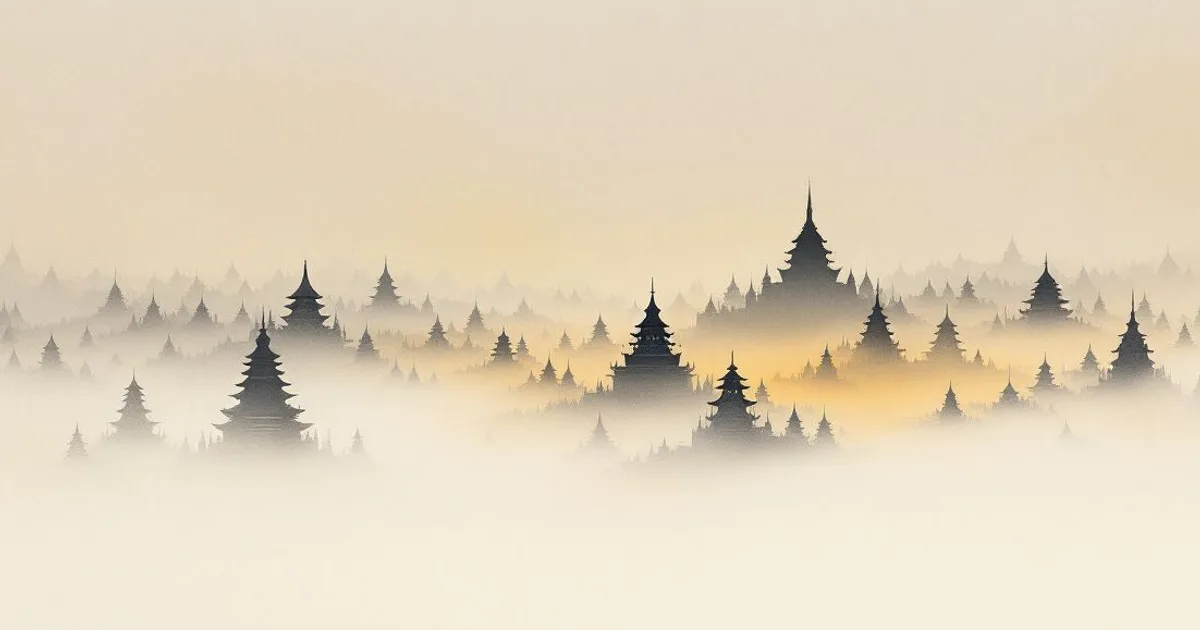
Buddhism in Myanmar (formerly Burma) is overwhelmingly Theravada, and it runs to the very core of national life. About 88% of the population is Buddhist (87.9% in the 2014 census), making Myanmar one of the most devout Buddhist societies on earth — a land of the great temple-plain of Bagan and of the modern insight-meditation revival that reshaped practice worldwide.
The short answer
Myanmar is, alongside Sri Lanka and Thailand, one of the classic Theravada nations — and by many measures the most intensely Buddhist of them all. Nearly nine in ten people are Buddhist, the monastic Sangha is enormous and deeply respected, and it is common for boys to be ordained as novices at least once in a rite of passage (shinbyu). Two things give Burmese Buddhism its special place in the wider tradition: the extraordinary sacred landscape of Bagan, and Myanmar’s role as the birthplace of the modern vipassanā (insight) movement that has since travelled across the world. To understand it is to see Theravada — one of the three great branches of Buddhism — at its most vivid. (Unfamiliar terms are in the glossary.)
How Buddhism shaped a nation
Buddhism became the organising force of Burmese civilisation in the 11th century, under King Anawrahta of Bagan (Pagan). According to Encyclopaedia Britannica, Anawrahta consolidated Theravada as the state religion — traditionally after acquiring scriptures and relics from the Mon kingdom of Thaton around 1057 — and launched one of the most astonishing eras of religious building in human history.
Over the following two centuries, the kings of Bagan and their subjects raised temples, stupas and monasteries across the dry plain of central Myanmar on a scale seen nowhere else. The tradition became inseparable from kingship, art and daily ethics, and it has remained the spiritual centre of national life ever since — through the classical kingdoms, the colonial period, and into the present, often as a wellspring of Burmese identity and resistance.
Bagan and the sacred landscape
The clearest window into this devotion is Bagan itself. Between the 11th and 13th centuries, more than 10,000 Buddhist monuments were built on the plain; roughly 2,200 survive today, a forest of spires and domes rising from the earth. In 2019 UNESCO inscribed Bagan as a World Heritage site, recognising it as one of the supreme achievements of Buddhist architecture — comparable in the Buddhist imagination to what Angkor is for Cambodia.
Myanmar’s other great shrine is the Shwedagon Pagoda in Yangon, a colossal gilded stupa that is the country’s most sacred site. By tradition, it enshrines relics of the present and past Buddhas, including eight hairs given by the Buddha himself to two merchant brothers — a devotional belief cherished by Burmese Buddhists, though its origins lie beyond the reach of historical verification. Whatever its age, the Shwedagon is the beating heart of Burmese devotion, ringed day and night by pilgrims offering flowers, water and light.
The land of the vipassana revival
Perhaps Myanmar’s greatest gift to modern Buddhism is a form of practice. In the 19th and 20th centuries, Burmese masters led a remarkable revival of vipassanā — insight meditation — and, crucially, opened it to lay people rather than reserving it for monks. Their influence now reaches around the globe.
- Ledi Sayadaw (1846–1923), a monk of immense learning, did much to bring meditation and Buddhist study to ordinary lay Burmese.
- From his lineage came Sayagyi U Ba Khin (1899–1971), a layman and senior civil servant who taught insight meditation to students including S. N. Goenka (1924–2013). Goenka carried the method from Burma to India and then worldwide, founding the global network of ten-day vipassanā courses.
- Independently, Mahasi Sayadaw (1904–1982) developed and spread the “noting” method of insight practice, which became one of the principal streams feeding the Western insight-meditation movement.
This Burmese inheritance runs directly into Western Buddhism. The revered laywoman Dipa Ma trained in this milieu, and teachers such as Joseph Goldstein and Sharon Salzberg learned Burmese methods before founding the insight movement in America. When a meditation app or a Western retreat centre teaches “noting” or a body-sweeping technique, the lineage very often traces back to Myanmar.
Buddhism, nationalism and the Rohingya crisis: an honest account
A truthful page about Buddhism in Myanmar cannot look away from the tragedy of recent years. It must be told carefully — factually, without sensationalism, and without letting it either be erased or made to define an entire tradition.
Over the past two decades, a current of Buddhist nationalism rose in Myanmar, expressed in movements such as 969 and the organisation Ma Ba Tha (formed 2014) and associated with monks like Ashin Wirathu. This current promoted anti-Muslim rhetoric and campaigned for “race and religion” laws.
That backdrop fed into a far graver catastrophe. After attacks by a Rohingya militant group in August 2017, Myanmar’s military (the Tatmadaw) launched operations in Rakhine State that drove more than 700,000 Rohingya Muslims into neighbouring Bangladesh. The UN High Commissioner for Human Rights described the campaign as “a textbook example of ethnic cleansing,” and in 2018 a UN Independent International Fact-Finding Mission concluded there was evidence of “genocidal intent” and called for senior generals to be prosecuted; a genocide case has since been heard at the International Court of Justice.
Two things must be held together honestly here. First, this was a state and military operation — an act of political and ethnic violence, not a teaching of Buddhism, and not the work of the Sangha as a whole. Second, Buddhist nationalism did help create a climate of hostility, which is precisely why it deserves to be named rather than excused. It is worth recording that Myanmar’s own supreme monastic authority, the State Sangha Maha Nayaka Committee, formally disavowed Ma Ba Tha in 2017, and that many Buddhist leaders inside and outside the country condemned the violence. The tradition of Bagan and the vipassanā masters is real; so is this history. A trustworthy account holds both without collapsing one into the other.
Myanmar among the traditions
Myanmar is Theravada Buddhism at its most deeply rooted — a nation of temples, a living monastic culture, and the source of meditation techniques now practised worldwide. Its story shows both the heights a Buddhist civilisation can reach and the danger, common to every religion, of faith being enlisted for nationalism. To place it in context, see our guide to Theravada Buddhism, its sister nations Sri Lanka and Thailand, the practice it gave the world in vipassana meditation, and the full map in Buddhism around the world and the branches of Buddhism.
Frequently asked questions
What percentage of Myanmar is Buddhist?
About 88% of Myanmar's population is Buddhist — 87.9% in the 2014 national census — and it is almost entirely Theravada. Myanmar (formerly Burma) is one of the most devoutly Buddhist societies in the world, with a large and socially central monastic Sangha. The remaining population is mainly Christian (about 6%), Muslim (about 4%) and Hindu.
What is Bagan?
Bagan is a vast archaeological plain in central Myanmar where the kings of the Pagan dynasty built thousands of Buddhist temples, stupas and monasteries, mainly between the 11th and 13th centuries. Over 10,000 monuments were once raised there; roughly 2,200 survive today. Bagan was inscribed as a UNESCO World Heritage site in 2019 and is one of the great monuments of the Buddhist world.
Why is Myanmar important for vipassana meditation?
Myanmar was the heartland of the modern revival of vipassana (insight) meditation that has since spread worldwide. Teachers such as Ledi Sayadaw, Mahasi Sayadaw and Sayagyi U Ba Khin systematised and popularised insight practice for lay people in the 19th and 20th centuries. U Ba Khin's student S. N. Goenka carried the method from Burma to India and the world, and the Mahasi method deeply shaped Western insight meditation.
What is the connection between Buddhism and the Rohingya crisis?
The Rohingya crisis was primarily a military and political catastrophe, not an act of Buddhism. After August 2017, Myanmar's armed forces drove more than 700,000 Rohingya Muslims into Bangladesh in what the UN human-rights chief called 'a textbook example of ethnic cleansing.' A current of Buddhist nationalism helped inflame anti-Muslim sentiment, but the violence was carried out by the state's military, and Myanmar's own supreme monastic authority disavowed the leading nationalist group in 2017.
Sources
- Myanmar Population and Housing Census 2014 — Union Report on Religion, Department of Population (2016): Buddhist 87.9%
- UNESCO World Heritage Centre — Bagan (inscribed 2019)
- Encyclopædia Britannica — 'Anawrahta' and the Pagan (Bagan) dynasty; the modern insight-meditation (vipassanā) revival
- UN Independent International Fact-Finding Mission on Myanmar, Report A/HRC/39/64 (2018) — finding of 'genocidal intent'; UN OHCHR (2017) — 'a textbook example of ethnic cleansing'