The Eight Auspicious Symbols of Buddhism (Ashtamangala)
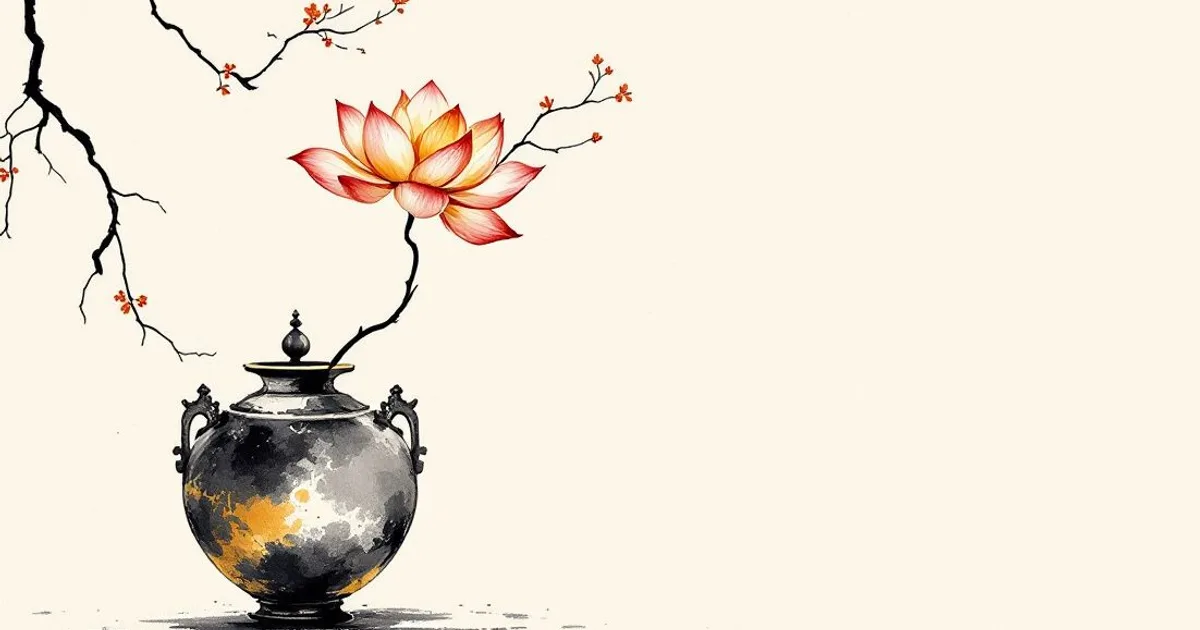
The Eight Auspicious Symbols (Sanskrit: aṣṭamaṅgala) are a set of eight ancient signs of good fortune — the parasol, a pair of golden fish, the treasure vase, the lotus, the conch, the endless knot, the victory banner, and the dharma wheel. Most prominent today in Tibetan Buddhism, they are of older Indian origin, and each points to an aspect of the Buddha’s teaching. They are among the best-known Buddhist symbols.
The short answer
The aṣṭamaṅgala (from Sanskrit aṣṭa, “eight,” and maṅgala, “auspicious”) are eight emblems of good fortune that are almost always shown as a set — carved on temples, painted on walls and furniture, printed on cloth, and offered as a blessing. They are especially beloved in Tibetan Buddhism, where you will see them everywhere, but it is important to be precise: the symbols are older than Buddhism, drawn from the auspicious signs of ancient India, and several appear in Hindu and Jain settings too. In their Buddhist meaning, each of the eight has come to stand for some quality of the Buddha, his awakening, or his teaching — so that the set as a whole is a compact picture of the whole path. (Unfamiliar terms are in the glossary.)
The eight symbols, one by one
Here are the eight, with their Sanskrit names and their usual Buddhist meanings. (The order varies from source to source; this is one common arrangement.)
- The Precious Parasol (chattra) — the parasol shaded royalty and the honored in ancient India, so it stands for protection, dignity, and royalty: here, shelter from the “heat” of suffering and harmful forces.
- The Golden Fish (a pair; usually given as suvarṇamatsya) — fish swim freely and without fear, so the pair signifies happiness, fertility, and freedom — the ease of a being who moves without fear through the ocean of existence. The two fish are also an old emblem of India’s sacred rivers, the Ganges and Yamuna.
- The Treasure Vase (kalaśa; Tibetan bumpa) — a vase of inexhaustible treasure signifies abundance and long life, and above all the endless treasury of the Dharma, which never runs dry however much is given away.
- The Lotus (padma) — rising unstained from muddy water to blossom in the light, the lotus is the great emblem of purity and renunciation — awakening growing out of, yet untouched by, the mud of the world.
- The Right-Turning Conch (śaṅkha) — the conch is a trumpet, and its sound stands for the proclamation of the Dharma, awakening beings from the sleep of ignorance. The auspicious conch is the rare one that spirals clockwise (dakṣiṇāvarta).
- The Endless Knot (śrīvatsa) — a looping knot with no beginning and no end, symbolizing the interdependence of all things and the union of wisdom and compassion. (We give it a full page of its own.)
- The Victory Banner (dhvaja) — a cylindrical banner of victory, marking the Buddha’s victory over ignorance and the forces of Māra — the triumph of the teaching over everything that obstructs awakening.
- The Dharma Wheel (dharmachakra) — the wheel of the teaching, whose eight spokes are the Noble Eightfold Path; setting it turning is the classic image for the Buddha giving his first teaching.
Taken together, the eight are less a random collection than a kind of visual summary of the tradition: protection and purity, the sound and the treasury of the teaching, the victory of awakening, the interdependence of all things, and the wheel of the path itself.
Where they come from
Here precision matters, because the symbols are often assumed to be uniquely Buddhist, and they are not.
Sets of eight auspicious symbols are older than Buddhism. As the scholar Robert Beer, whose Handbook of Tibetan Buddhist Symbols is the standard reference, explains, groupings of eight auspicious signs “were originally used in India at ceremonies such as an investiture or coronation of a king.” They belong to the shared symbolic vocabulary of ancient India, and versions appear in Hinduism and Jainism as well — though the Jain list of eight is a different set, not identical to the Buddhist one. (For this reason, general reference entries on “ashtamangala” sometimes describe the Jain symbols rather than these.)
Buddhism then gave the eight its own reading. In one traditional account, the symbols represent offerings the great gods made to the Buddha at his enlightenment: Brahmā, for instance, is said to have offered a thousand-spoked golden wheel, requesting the Buddha to “turn the wheel of the Dharma,” and Indra to have offered a white, right-spiralling conch. Whatever the precise legend, the eight were absorbed above all into Tibetan Buddhist art and ritual, where they became the flourishing, ubiquitous set known today.
How they are used
In practice the aṣṭamaṅgala function as a blessing and an adornment. They are painted and carved on monastery walls, thrones, doorways, and ritual objects; drawn in powder or laid out at ceremonies; printed on hangings and gifts; and offered — individually or as a group — to invoke good fortune and to honor the Dharma. In Tibetan homes and temples they appear so often that they become a quiet visual reminder of the teaching woven through daily life.
They are not worshipped as powers in themselves. Like all Buddhist symbols, they are pointers — each a small, beautiful shorthand for something the Buddha taught. To follow the one with the richest philosophical meaning, see the endless knot; for the two that are central symbols in their own right, the dharma wheel and the lotus; and for the wider family of Buddhist imagery, our guide to Buddhist symbols and their meanings.
Frequently asked questions
What are the Eight Auspicious Symbols?
The Eight Auspicious Symbols (Sanskrit: ashtamangala) are a set of eight ancient signs of good fortune, especially prominent in Tibetan Buddhism, where they are often shown together and offered as a blessing. They are: the precious parasol, a pair of golden fish, the treasure vase, the lotus, the right-turning conch shell, the endless knot, the victory banner, and the dharma wheel. Each points to an aspect of the Buddha and his teaching.
Are the Eight Auspicious Symbols only Buddhist?
No. Although this exact eightfold set is closely associated with Tibetan Buddhism today, the symbols are of ancient Indian, pre-Buddhist origin and appear across Hinduism and Jainism as well. Groups of eight auspicious signs were used in early India at royal ceremonies such as coronations. Jainism has its own eight auspicious symbols, which are a different list. So the ashtamangala are best described as pan-Indian in origin and Tibetan-Buddhist in their most familiar modern form.
What does each of the eight symbols mean?
In the usual Buddhist reading: the parasol is protection and dignity; the golden fish, happiness and freedom in the ocean of existence; the treasure vase, abundance and the treasury of the Dharma; the lotus, purity rising unstained from the mud; the conch, the sound of the Dharma; the endless knot, the interdependence of all things and the union of wisdom and compassion; the victory banner, the Buddha's victory over ignorance; and the wheel, his teaching and the Eightfold Path.
Where do the Eight Auspicious Symbols come from?
They predate Buddhism. According to the scholar Robert Beer, sets of eight auspicious symbols were originally used in India at ceremonies such as the coronation of a king. Buddhism later reinterpreted them: in one traditional account, the eight represent offerings that the great gods presented to the Buddha at his enlightenment — for example, Brahma offering a golden wheel and asking him to teach. They were adopted especially into Tibetan Buddhist art and ritual.
Sources
- Robert Beer, 'The Handbook of Tibetan Buddhist Symbols' (Shambhala, 2003) — the standard reference on the aṣṭamaṅgala
- Rubin Museum of Himalayan Art — the Eight Auspicious Symbols
- Encyclopædia Britannica — 'Aṣṭamaṅgala' (note: the entry treats the Jaina set, which differs from the Buddhist one)