The Endless Knot: Meaning of the Buddhist Symbol
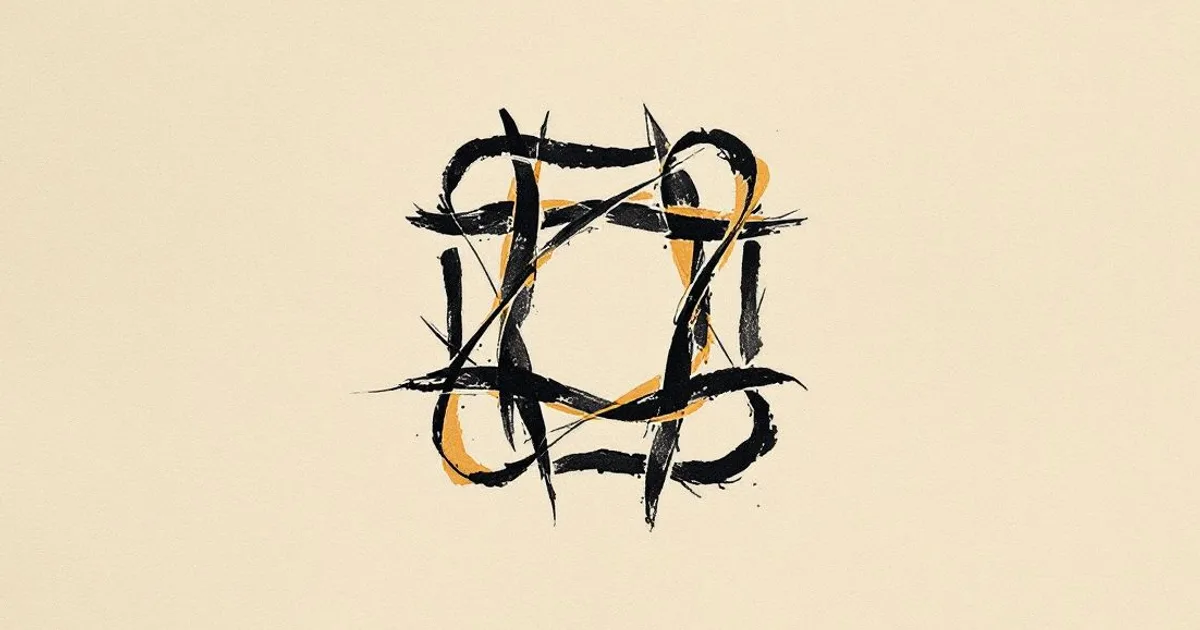
The endless knot (Sanskrit: śrīvatsa; Tibetan: dpal be’u) is one of Buddhism’s Eight Auspicious Symbols — a single looping design with no beginning and no end. Its interwoven lines symbolize the interdependence of all things and, in a favourite Tibetan reading, the union of wisdom and compassion. It is among the most philosophically rich of all Buddhist symbols.
The short answer
Look at an endless knot and you cannot find where it starts or where it stops: a continuous line loops over and under itself, closed and complete. That simple fact is the whole meaning. Because it has no beginning and no end, the knot stands for the interconnectedness of everything — the way, in Buddhist understanding, no thing exists on its own but only in dependence on countless others. It also carries a cluster of related meanings especially loved in Tibetan Buddhism: the endless cycle of existence, the unbroken continuity of the awakened mind, and above all the inseparable union of wisdom and compassion. It is one of the eight aṣṭamaṅgala, and arguably the one that says the most. (Unfamiliar terms are in the glossary.)
A knot with no beginning or end
The endless knot’s power is in its geometry. Unlike a symbol you “read” — a wheel, a lotus, a flame — the knot works by a property of its shape: it has no loose ends. Trace the line and it returns to itself forever. There is no first point from which it begins and no last point at which it stops.
This is why it resists being flattened into a mere decorative flourish or a generic “infinity” sign. The endlessness is not just visual cleverness; it is the meaning. In a tradition whose deepest teachings are about how things arise together, without any independent starting point, a closed and beginningless knot is close to a perfect emblem.
What the endless knot means
Because its form is so suggestive, the endless knot has gathered several linked meanings, all of them attested in the Tibetan tradition and each illuminating the others:
- The interdependence of all things. This is the core reading. Everything is woven together with everything else — arising in mutual dependence, not in isolation. The knot is a picture of that seamless interweaving, the truth the Buddhist teaching of emptiness and dependent arising points to.
- The union of wisdom and compassion. In a favourite Tibetan interpretation, the intertwining lines represent the inseparable joining of wisdom (prajñā) and compassion (karuṇā) — or, in a closely related reading, of wisdom and skilful method (upāya) — in the mind of an awakened being. Neither can be pulled free of the other; like the knot, they are bound together.
- The endless cycle of existence. The unbroken line can also evoke saṃsāra, the beginningless round of birth, death, and rebirth — and, on the far side of it, the eternal continuum of the awakened mind, which does not end.
These are not competing meanings so much as facets of one insight: that reality is a continuous, interdependent whole, and that the awakened response to it — wisdom and compassion together — is likewise seamless.
The endless knot in other cultures
A brief word to prevent a common confusion. Interlaced, “endless” knot designs appear in many cultures with no shared origin — the Chinese decorative “mystic knot,” Celtic knotwork, and various folk motifs among them. These are genuinely separate traditions, and it would be a mistake to treat them as one symbol.
The Buddhist endless knot’s meaning, and its place among the Eight Auspicious Symbols, belongs above all to Tibetan Buddhism, while the underlying śrīvatsa emblem is of ancient Indian origin and appears in Hindu and Jain art as well. When you see the knot on a Tibetan hanging, a temple wall, or a piece of jewellery, it is this lineage of meaning — interdependence, and the union of wisdom and compassion — that it carries.
For the full set it belongs to, see the Eight Auspicious Symbols; for the teaching it so beautifully pictures, emptiness and interdependence; and for the wider family of imagery, Buddhist symbols and their meanings.
Frequently asked questions
What does the endless knot symbolize in Buddhism?
The endless knot (Sanskrit: śrīvatsa; Tibetan: dpal be'u) is a looping design with no beginning and no end, and it carries several linked meanings. It symbolizes the interdependence and interconnectedness of all things, the endless cycle of existence (samsara), the eternal continuum of the awakened mind, and — a favourite Tibetan reading — the union of wisdom and compassion (or wisdom and skilful method) in the Buddha's enlightenment.
Is the endless knot the same as the infinity symbol?
No. While both suggest endlessness, the endless knot is not simply a mathematical infinity sign. It is one of Buddhism's Eight Auspicious Symbols, and its specific meaning is about interdependence — how everything is woven together with everything else — and the inseparable union of wisdom and compassion. Reducing it to a generic 'infinity' symbol misses that particular teaching.
Is the endless knot only a Buddhist symbol?
The endless knot's Buddhist meaning belongs above all to Tibetan Buddhism, where it is one of the Eight Auspicious Symbols, and the underlying śrīvatsa emblem is of ancient Indian origin, appearing in Hindu and Jain art too. Interlaced 'endless knot' designs also exist independently in other cultures — such as the Chinese decorative 'mystic knot' and Celtic knotwork — but these are separate traditions, not the same symbol with a shared origin.
What is the endless knot's name in Sanskrit and Tibetan?
In Sanskrit it is the śrīvatsa; in Tibetan, dpal be'u (often written palbeu or pelbeu). The Tibetan name combines dpal — which renders the Sanskrit śrī, 'glory' or 'splendour' — with be'u, 'little knot,' so it translates the Sanskrit term quite directly. It is counted among the ashtamangala, the Eight Auspicious Symbols.
Sources
- Tibetan Nuns Project — 'The Eternal Knot Symbol' (palbeu / śrīvatsa; its meanings)
- Robert Beer, 'The Handbook of Tibetan Buddhist Symbols' (Shambhala, 2003)
- Rubin Museum of Himalayan Art — the Eight Auspicious Symbols