Mudras: Buddhist Hand Gestures & Meanings
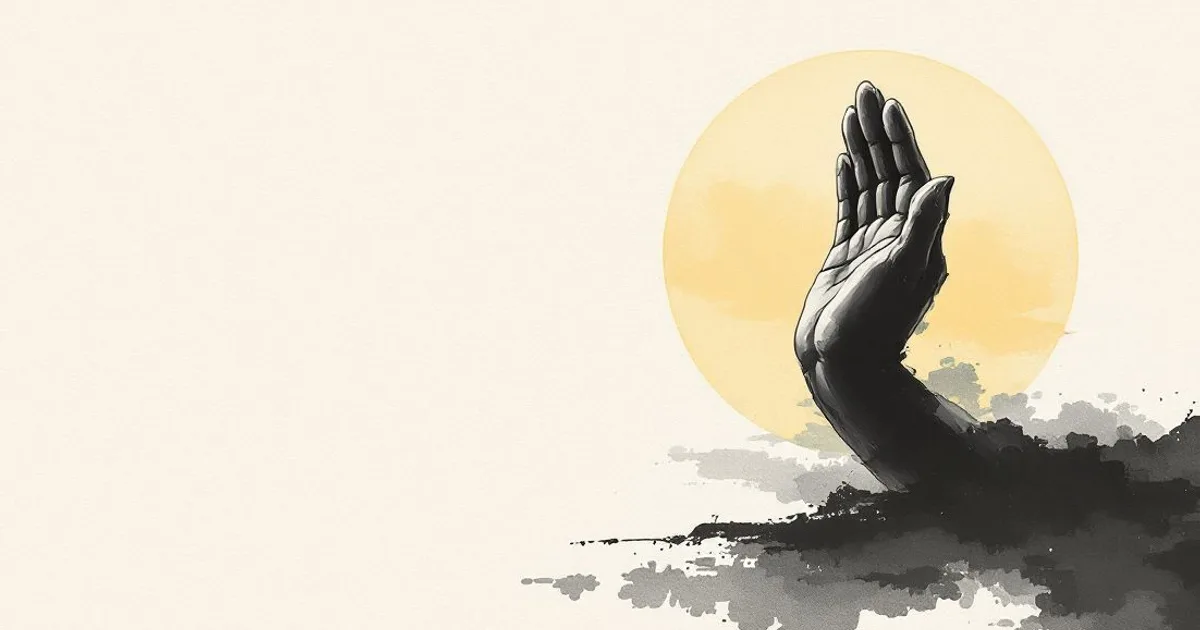
Mudras are the symbolic hand gestures of Buddhist art and practice — a precise visual language in which the hands of a Buddha or bodhisattva convey a specific meaning or recall a key moment. A hand resting in the lap means meditation; fingertips touching the earth mean the enlightenment; a raised palm means “have no fear.” To “read” a Buddha statue is very largely to read its hands. It is one of the most rewarding keys to all of Buddhist art and symbolism.
What a mudra is
The word mudra means “seal” or “sign,” and in Buddhist iconography it names the codified positions of the hands that appear again and again in statues and paintings across every tradition. They are not decorative; they are a grammar. An artist choosing a mudra is telling you which Buddha this is, or which moment of the Buddha’s life is being shown. Learn a handful of them and a gallery of once-mysterious images begins, quietly, to speak.
Mudras belong to Buddhist art broadly — Theravada, Mahayana, and Vajrayana alike — and they also live in ritual: in Tibetan (Vajrayana) practice especially, the hands form specific mudras to accompany specific meditations. This page is a guide to the gestures themselves; for reading a whole statue — its posture, its attributes, its setting — see our companion guide to Buddha statues and their meaning.
The major mudras
A handful of gestures account for the great majority of Buddha images.
- Dhyana mudra — meditation. Both hands rest in the lap, one upon the other (traditionally right over left), palms upward, the thumbs sometimes lightly touching. This is the gesture of meditative absorption, and it recalls the Buddha in deep meditation before his awakening.
- Bhumisparsha mudra — earth-touching. The right hand drapes over the right knee, fingertips reaching down to touch the ground; the left rests in the lap. This is the gesture of enlightenment: challenged to prove his worthiness to awaken, the Buddha touched the earth and called it to witness. It is perhaps the single most common of all Buddha images.
- Abhaya mudra — fearlessness. The right palm is raised, facing outward at about shoulder height, fingers up. It signifies protection, reassurance, and the absence of fear — the Buddha calming and offering safety.
- Varada mudra — giving. An open hand, palm outward, fingers pointing down. It expresses generosity, charity, and compassion — the granting of a boon. It often appears alongside the abhaya mudra, one hand raised in reassurance and the other lowered in giving.
- Dharmachakra mudra — turning the wheel. Both hands are held at the level of the chest, the thumb and forefinger of each forming a circle, the hands touching. It evokes the first teaching — the “turning of the wheel of Dharma” — that the Buddha gave at Sarnath.
- Vitarka mudra — discussion. The thumb and forefinger touch to form a circle, the other fingers extended, the palm outward. It is the gesture of teaching, exposition, and debate — the transmission of the Dharma in words.
- Anjali mudra — reverence. The palms are pressed together at the heart. This is the gesture of greeting, veneration, and devotion, seen most often on attendants and worshippers, and used by practitioners themselves in bowing and prostration.
Mudras in meditation and ritual
Mudras are not only carved in stone; practitioners form them too. Sitting to meditate, one may rest the hands in the dhyana mudra — the very gesture the seated Buddha is shown holding — and, bowing at a shrine, one joins the palms in añjali. In Tibetan (Vajrayana) practice especially, the hands form precise mudras to accompany particular meditations, mantras, and visualisations, so that gesture, word, and mind work as one. What the statues freeze into stone, the living tradition performs with its own hands.
How to read them
Two cautions keep the reading honest. First, the positions are a broad convention, not an iron rule: regional styles vary, the giving hand may be left or right, and gestures are freely combined (the raised-and-lowered pairing of abhaya and varada is a favourite). Second, mudras are iconographic language, not occult machinery — they are meaning made visible, not spells. It is also worth resisting the popular tables that assign a fixed “element” to each finger as though it were canonical Buddhist doctrine; those are later overlays, not part of the tradition’s own account.
Read this way, the hands of a Buddha image become a kind of silent scripture. The next time you meet one, look first at what the hands are doing — meditating, touching the earth, calming your fear, turning the wheel — and the statue will tell you its story. For the fuller art of reading an image, see Buddha statues and their meaning; for the gesture at the heart of enlightenment, the Buddha’s awakening; and for the wider vocabulary, Buddhist symbols. Unfamiliar terms are in the glossary.
Frequently asked questions
What is a mudra in Buddhism?
A mudra is a symbolic hand gesture. In Buddhist art, the hands of a Buddha or bodhisattva are arranged in one of a set of codified positions, each conveying a specific meaning or recalling a key moment — meditation, the enlightenment, teaching, reassurance, and so on. To 'read' a Buddha statue is largely to read its mudra. Mudras also appear in ritual, especially in Vajrayana practice, where they accompany specific meditations.
What are the main Buddhist mudras?
The most common are the dhyana mudra (meditation, hands resting in the lap); the bhumisparsha mudra (earth-touching, the gesture of enlightenment); the abhaya mudra (fearlessness, a raised open palm); the varada mudra (giving and compassion, a downturned open palm); the dharmachakra mudra (turning the wheel of Dharma, or teaching); the vitarka mudra (discussion, thumb and forefinger touching); and the anjali mudra (palms pressed together in reverence).
What is the bhumisparsha mudra?
The bhumisparsha, or 'earth-touching,' mudra shows the right hand reaching down over the knee with the fingertips touching the ground, while the left hand rests in the lap. It depicts the moment of the Buddha's enlightenment, when — challenged by Mara to prove his right to awaken — he touched the earth and called it to witness. It is one of the most common of all Buddha images.
Are mudras magic hand signs?
No. Mudras are a symbolic, iconographic language — a visual vocabulary of the Buddha's key acts and qualities — not spells that compel results. In Vajrayana ritual, certain mudras accompany specific practices as part of a disciplined method, but even there they are supports for meditation and devotion, not magical gestures. Treat them as meaning made visible in the hands.
Sources
- Khan Academy, 'Mudras in Buddhist art' — the names, hand positions, and meanings of the principal mudras (dhyana, bhumisparsha, abhaya, varada, dharmachakra, vitarka)
- Smarthistory, 'Mudras in Buddhist art' — an academic art-history treatment of the gestures and their iconographic function
- Robert Beer, 'The Handbook of Tibetan Buddhist Symbols' — the mudras in their Vajrayāna ritual dimension