Butter Lamps: The Tibetan Buddhist Light Offering
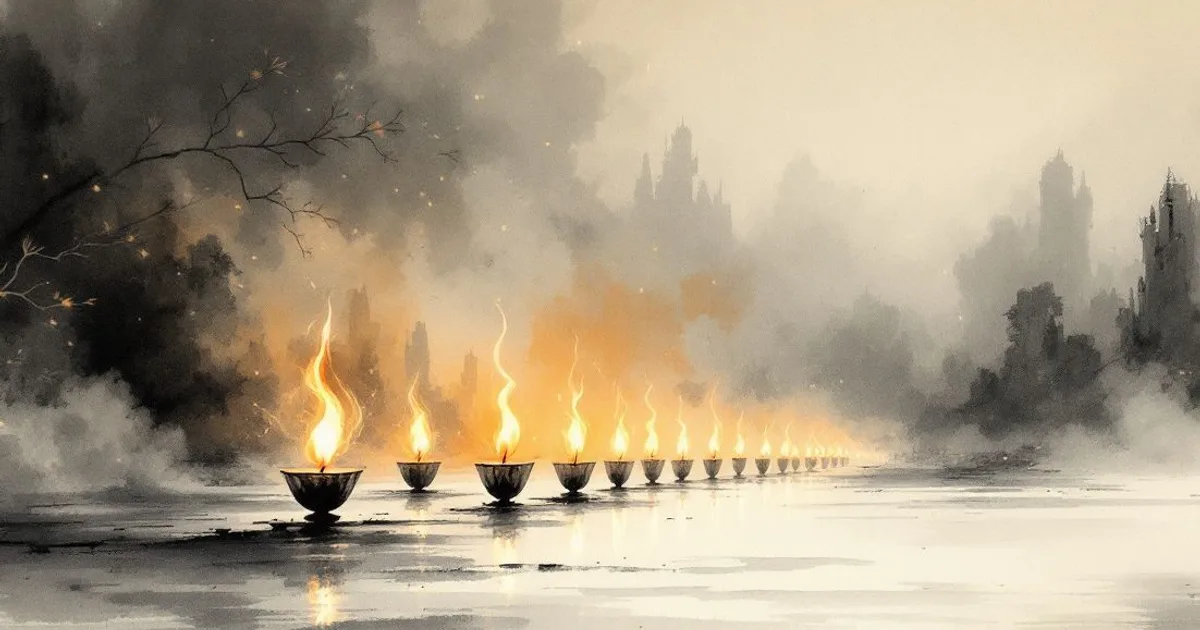
Butter lamps (Tibetan: mar me) are the Tibetan Buddhist form of the offering of light — lamps traditionally burning clarified yak butter, lit in rows before shrines and images. Their meaning is luminous and simple: light dispels darkness, as wisdom dispels ignorance. The offering of light is found across Buddhism; the butter lamp itself belongs to the Tibetan and Himalayan world.
The short answer
Walk into a Tibetan Buddhist temple and you will often meet a wall of soft golden flames — hundreds of small butter lamps, burning steadily before the images. A butter lamp is exactly what it sounds like: a lamp whose fuel is clarified butter, traditionally from the dri (the female yak), with a wick standing in it. Offering these lamps is one of the most beloved devotional acts in Tibetan Buddhism, and its symbolism is one of the most universal in all religion: light overcoming darkness — and, read spiritually, the wisdom that overcomes the darkness of ignorance. As with the whole family of Buddhist symbols, the object is a pointer: the flame is a prayer made visible. (Unfamiliar terms are in the glossary.)
What a butter lamp is
A butter lamp is a small bowl or cup — often of brass, silver, or precious metal in fine examples — holding clarified butter as fuel, with a wick set upright in the centre. Traditionally the butter came from the dri, the female yak of the Tibetan plateau, whose rich butter was a staple of Himalayan life. In modern times, and especially among Tibetans in exile where yak butter is scarce, the lamps are frequently filled with ghee or vegetable fat instead.
Lamps may be lit singly as a daily offering or, on special occasions, in great banks of dozens or hundreds, tended by monks and lay devotees so that the flames burn continuously. The sight — and the warm, particular smell of butter smoke — is one of the sensory signatures of a Tibetan temple.
What the butter lamp means
The meaning rests on the oldest of symbols: light against darkness. In Buddhist terms, the darkness is ignorance (avidyā) — the fundamental not-seeing that, in the Buddhist analysis, lies at the root of suffering. The steady flame of the lamp stands for the light of wisdom that dispels it. To offer a lamp is to express the wish that the light of understanding overcome the darkness of confusion — for oneself, and for all beings.
Light is also one of the traditional categories of offering in Tibetan Buddhism. In the standard set of offerings — represented, for instance, by the row of offering bowls on a shrine, or as part of making offerings generally — the light offering (Sanskrit āloka) has its fixed place alongside water, flowers, incense, perfume, food, and sound. The butter lamp is that light offering made real.
When butter lamps are offered
Butter lamps are lit on many occasions:
- as a daily devotion before the shrine, statues, and images of the Buddha and the teachers;
- for the sick, as a prayer for healing and clarity;
- for the deceased, in the days and weeks after a death, to generate merit and to light their way;
- at auspicious events — birthdays, weddings, wishes for success;
- and above all, in vast numbers, at festivals — especially around Losar, the Tibetan New Year, and on the great days commemorating the Buddha’s life, when temples and homes blaze with light.
In every case the act is understood as one of generosity and merit — a small, warm gift of light offered freely, and a moment of positive intention kindled along with the flame.
Light everywhere, butter lamps in Tibet
One distinction is worth drawing clearly. The offering of light is pan-Buddhist: Theravāda Buddhists light lamps and lanterns at Vesak, floating-lantern ceremonies glow across Buddhist Asia, and East Asian Buddhists offer candles and lamps before their altars. The impulse to answer darkness with light is common to the whole tradition.
The butter lamp specifically — burning yak butter or ghee — is a Tibetan and Himalayan form, at home in Tibet, Nepal, Bhutan, and the wider Himalayan Buddhist world. So the accurate way to put it is this: offering light is something Buddhists everywhere do; the butter lamp is how the Tibetan world does it. Keeping that line clear is part of honouring each tradition on its own terms.
To place the lamp among the offerings, see making offerings and the seven offering bowls; for its sister objects, prayer wheels, prayer flags, and the khata scarf; and for the wider picture, Buddhist symbols and their meanings.
Frequently asked questions
What are Tibetan butter lamps?
Butter lamps (Tibetan: mar me) are lamps offered in Tibetan Buddhism, traditionally burning clarified butter from the dri (the female yak), with a wick set in the fuel. Rows of them are lit before shrines and images. Today, especially in exile, they often use ghee or vegetable fat instead of yak butter. They are the Tibetan form of the offering of light, which symbolizes wisdom dispelling the darkness of ignorance.
What do butter lamps symbolize?
Light dispelling darkness — and, spiritually, wisdom dispelling ignorance (avidya), which in Buddhism is the root of suffering. Offering a lamp expresses the wish for the light of understanding to overcome the darkness of confusion, for oneself and for all beings. Light is one of the traditional categories of offering in Tibetan Buddhism, alongside water, flowers, incense, and the rest.
When are butter lamps offered?
They are offered before shrines, statues, and images as a daily devotion, and in large numbers on special occasions: for the sick, in memory of and to benefit the deceased, and at auspicious events. Enormous numbers are lit during festivals — especially around Losar, the Tibetan New Year, and on days commemorating the Buddha. Lighting a lamp is understood as making merit and generating positive intention.
Are butter lamps used in all of Buddhism?
The offering of light is found across Buddhism — Theravada Buddhists light lamps and lanterns at Vesak, and East Asian Buddhists offer lamps and candles too. But the butter lamp specifically — burning yak butter or ghee — is a Tibetan and Himalayan form. So it is accurate to say that offering light is pan-Buddhist, while the butter lamp itself belongs to Tibetan and Himalayan Buddhism.
Sources
- Tibetan Nuns Project — 'Tibetan Butter Lamps' (clarified butter from the dri; light dispelling ignorance)
- Robert Beer, 'The Handbook of Tibetan Buddhist Symbols' (Shambhala, 2003) — the offering of light (āloka)
- The seven/eight offering bowls: the light offering (Skt. āloka), corroborated across reputable Tibetan-Buddhist sources