Prayer Wheels: The Tibetan Buddhist Mani Wheel
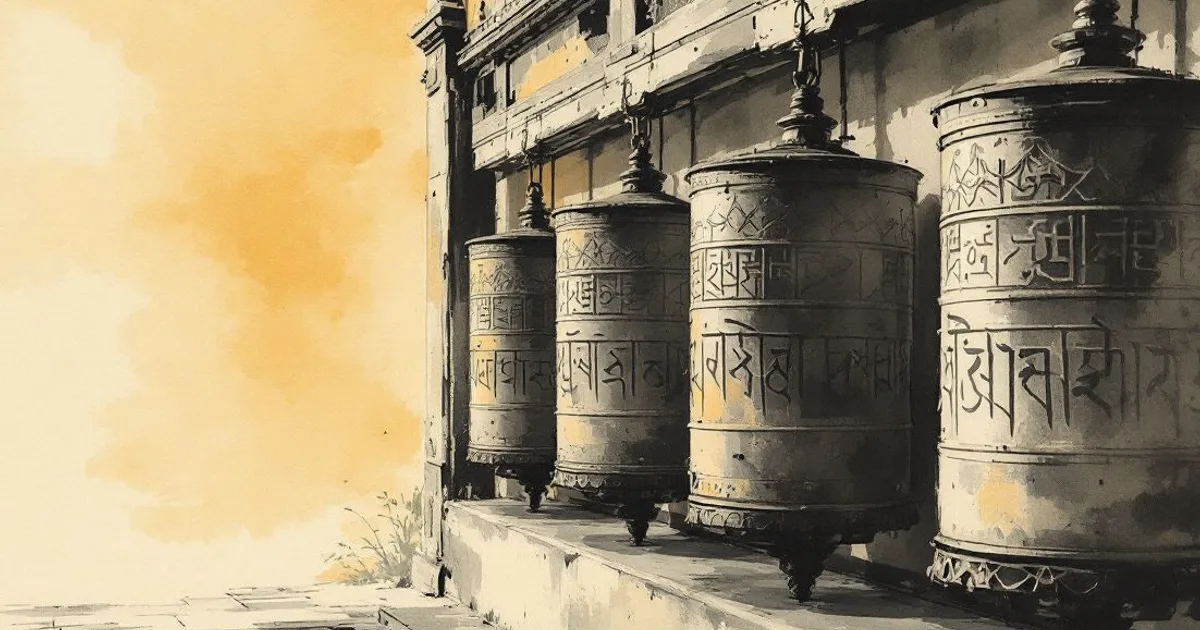
A prayer wheel is a device used specifically in Tibetan Buddhism: a cylinder filled with tightly rolled mantras that, when spun clockwise, is held to be equivalent to reciting them. Most contain Oṃ Maṇi Padme Hūṃ, the mantra of Avalokiteśvara, the bodhisattva of compassion. It is one of the most recognisable Buddhist symbols — and one it is important to label precisely.
The short answer
The prayer wheel is a beautifully simple idea. As Encyclopaedia Britannica puts it, in Tibetan Buddhism it is “a mechanical device the use of which is equivalent to the recitation of a mantra.” Inside a hollow cylinder are scrolls printed with mantras, wound tightly around the central spindle; the same mantra is often embossed on the outside. To use it, you turn the cylinder clockwise, and each rotation is understood to release the prayers within — as if you had recited every one of them aloud. It is, above all, a practice of compassion and merit, and it belongs to the Tibetan and Himalayan world, not to Buddhism as a whole. (Unfamiliar terms are in the glossary.)
What a prayer wheel is
Physically, a prayer wheel (Tibetan: the maṇi wheel) is a cylinder on a handle or axle, weighted so it spins smoothly. The heart of it is the tightly wound paper scroll inside, printed over and over with a mantra — sometimes many thousands or millions of repetitions in a single wheel. The exterior is usually decorated, and frequently carries the mantra in raised letters and the eight auspicious symbols.
The logic is that of the mantra made physical. Where a practitioner might sit and recite a mantra a set number of times, the wheel stores the written mantra by the thousandfold and “recites” them all with a single turn. It externalises and multiplies a practice of the voice into a practice of the hand.
Oṃ Maṇi Padme Hūṃ: the mantra inside
Most prayer wheels are filled with one mantra above all: Oṃ Maṇi Padme Hūṃ, the six-syllable mantra of Avalokiteśvara — the bodhisattva of compassion, known in Tibet as Chenrezig, of whom the Dalai Lamas are considered emanations. It is the most widely recited mantra in Tibetan Buddhism, chanted, carved on stones, and printed on flags across the Himalaya.
Its meaning is often rendered loosely as “the jewel in the lotus,” but scholars debate the precise translation, and it is safest to understand it not as a sentence to be parsed but as the sound-form of compassion itself — a condensed invocation of Avalokiteśvara’s awakened qualities. When it fills a prayer wheel, every turn is a turning of that compassion out into the world.
How and why they are turned
Prayer wheels are turned clockwise — the direction in which the mantras are written, so that they are “read” in the right order, and the same auspicious clockwise direction in which pilgrims circumambulate a stupa. To spin one the wrong way is generally thought to undo the good, so the direction is observed with care.
The purpose is the accumulation of merit and wisdom and the purification of negative karma, both for the person turning the wheel and, in the Tibetan understanding, for all beings — each rotation is believed to send the compassion of the mantra out into the world for the benefit of everyone. Turning a prayer wheel is thus a small, repeatable act of the same aspiration that animates all Tibetan Buddhist practice: the wish to relieve the suffering of others.
Forms of the prayer wheel
Prayer wheels come in several forms:
- Hand-held wheels (mani wheels), weighted with a small chain, spun continuously in one hand while walking or reciting.
- Large fixed wheels, often set in long rows along a temple wall or around a shrine, which pilgrims turn one after another as they walk clockwise past them.
- Water- and wind-powered wheels, and even heat-powered ones, kept in constant motion by a stream or the breeze so that the mantras turn day and night without a human hand.
From a tiny wheel in a pilgrim’s palm to a giant drum in a monastery courtyard, the principle is the same: to keep compassion, quite literally, in motion.
A Tibetan practice, precisely
One clarification is worth making plainly, because the prayer wheel is so often described simply as “Buddhist.” It is not a practice of Buddhism in general. The prayer wheel is specifically Tibetan and Himalayan Vajrayāna — you will not find it in Theravāda Buddhism or in most of East Asian Buddhism. It is one of the distinctive expressions of the Tibetan path, alongside prayer flags, butter lamps, the khata scarf, and the sand mandala. Naming it precisely is part of respecting the tradition it actually belongs to.
For the compassion it carries, see Avalokiteśvara; for the practice of mantra itself, mantra meditation; and for its sister objects, prayer flags and the wider guide to Buddhist symbols.
Frequently asked questions
What is a Buddhist prayer wheel?
A prayer wheel is a device used specifically in Tibetan Buddhism: a hollow cylinder mounted on a spindle, filled with tightly rolled scrolls printed with mantras and often inscribed on the outside. Spinning the wheel is held to be equivalent to reciting the mantras inside it, generating merit and compassion. Most prayer wheels contain the mantra of Avalokiteshvara, the bodhisattva of compassion: Om Mani Padme Hum.
Which way do you spin a prayer wheel?
Clockwise. Prayer wheels are turned clockwise — the direction in which the mantras inside are written, so that they are 'read' correctly, from left to right — and, like circumambulating a stupa, this follows the auspicious clockwise direction of Tibetan practice. Turning it the wrong way is generally considered to undo the benefit, so the clockwise motion is observed carefully.
What is written inside a prayer wheel?
Tightly wound scrolls printed with mantras — often many thousands or even millions of repetitions. The most common is Om Mani Padme Hum, the six-syllable mantra of Avalokiteshvara (Tibetan: Chenrezig), the bodhisattva of compassion. The number of mantras inside is not fixed and varies from wheel to wheel; larger temple wheels may hold vast quantities.
Do all Buddhists use prayer wheels?
No — prayer wheels are specifically a Tibetan and Himalayan Vajrayana practice. They are not part of Theravada Buddhism or most East Asian Buddhist traditions. So while the prayer wheel is one of the most recognisable objects of Tibetan Buddhism, it should not be described as a practice of Buddhism in general.
Sources
- Encyclopædia Britannica — 'Prayer wheel' (a Tibetan Buddhist device whose use is equivalent to reciting a mantra)
- Rubin Museum of Himalayan Art — prayer wheel (the mantra of Avalokiteśvara; turned clockwise; merit)
- Robert Beer, 'The Handbook of Tibetan Buddhist Symbols' (Shambhala, 2003)